 KINSMC
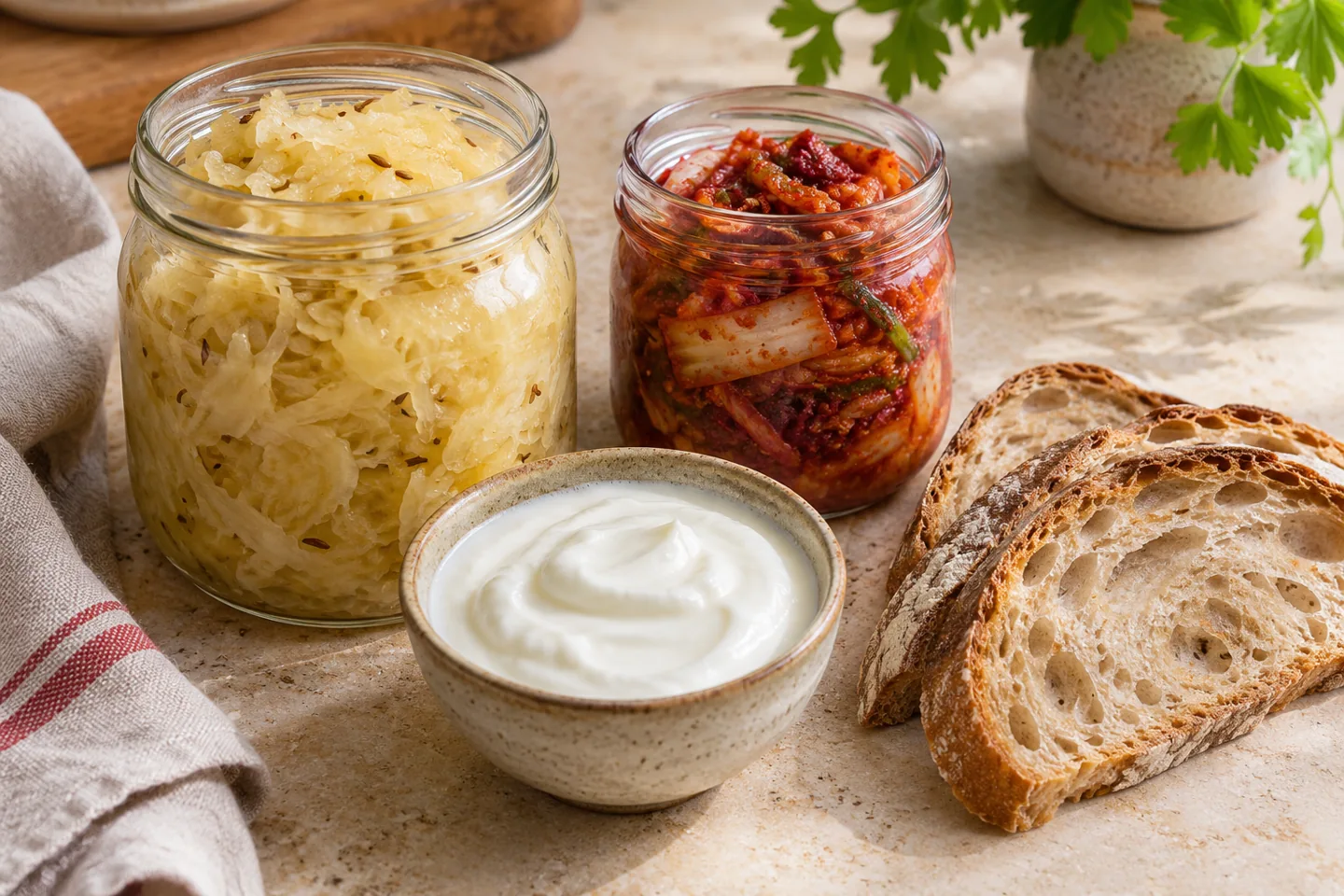
A fermented food is not automatically a probiotic food. Fermentation describes how a food is made. “Probiotic” describes live microorganisms that, in adequate amounts, have demonstrated a health benefit. The terms answer different questions.
The key difference in one table
| Term | What it tells you | What it does not establish |
|---|---|---|
| Fermented | Microorganisms were involved in making the food | That living microbes remain when it is eaten |
| Live cultures | The product contains living microorganisms | A demonstrated benefit for the specific cultures and amount |
| Probiotic | Live microorganisms with evidence of a health benefit at an adequate dose | That every fermented product has the same effect |
The International Scientific Association for Probiotics and Prebiotics (ISAPP) explains these distinctions in its fermented-food resources and its article Do fermented foods contain probiotics?.
Why a fermented food may have no living microbes
What happens after fermentation matters. A later heating step can kill the microorganisms involved. Bread, for example, is made using fermentation and then baked. The fact that fermentation was part of its production does not turn a slice of bread into a probiotic product.
This does not make fermentation pointless. It can change flavour, texture and other characteristics of a food. It simply means that “fermented” is a description of a process, rather than a promise about live organisms at the point of eating.
Why live cultures are not the whole story
A food may contain living microbes without evidence that those particular organisms, in the amount supplied, produce a specified benefit. ISAPP’s explanation links probiotic claims to research on the microorganisms concerned. A result for one studied strain cannot automatically be assigned to every fermented food on a supermarket shelf.
Be especially careful with broad statements such as “all fermented foods fix gut problems.” Such wording skips the details of the product, the research and the person eating it. No single benefit can be assumed from the word “fermented” alone.
A practical shopping checklist
- Identify the actual food. Choose something you enjoy and can use in ordinary meals, rather than buying solely for a front-label claim.
- Read processing and storage information. Look for instructions about refrigeration and wording about heat treatment or live cultures. Do not infer these from the product category alone.
- Read any health claim carefully. Ask whether it names the microorganism and the benefit, and whether evidence is available for that claim.
- Check the rest of the label. Serving size, salt, sugar, ingredients and allergens still matter.
- Follow the package instructions. Storage and use-by guidance belong to the particular product.
For the sugar part of that comparison, see our guide to added sugar and total sugar. It explains why those two values should not be added together.
Common questions
Is every yoghurt a probiotic?
Do not assume that a product’s category establishes a particular probiotic claim. Check its cultures and the evidence behind the benefit being described.
Are pickled and fermented the same thing?
Not always. Some foods are preserved by adding an acid such as vinegar rather than relying on microbial fermentation. Check how the product was made.
Should I make fermented food at home to get probiotics?
Home fermentation does not establish a known probiotic strain, dose or benefit. This article is not a fermentation-safety recipe; use a reliable, food-specific preparation and storage method if making fermented foods.
Sources and editorial note
This AI-assisted KINSMC article draws on the ISAPP resources linked above and background reading from Christopher Gardner’s Food Sense: What to Eat and Why, chapter 13. It explains terminology and does not recommend a probiotic product or offer treatment advice.