 KINSMC
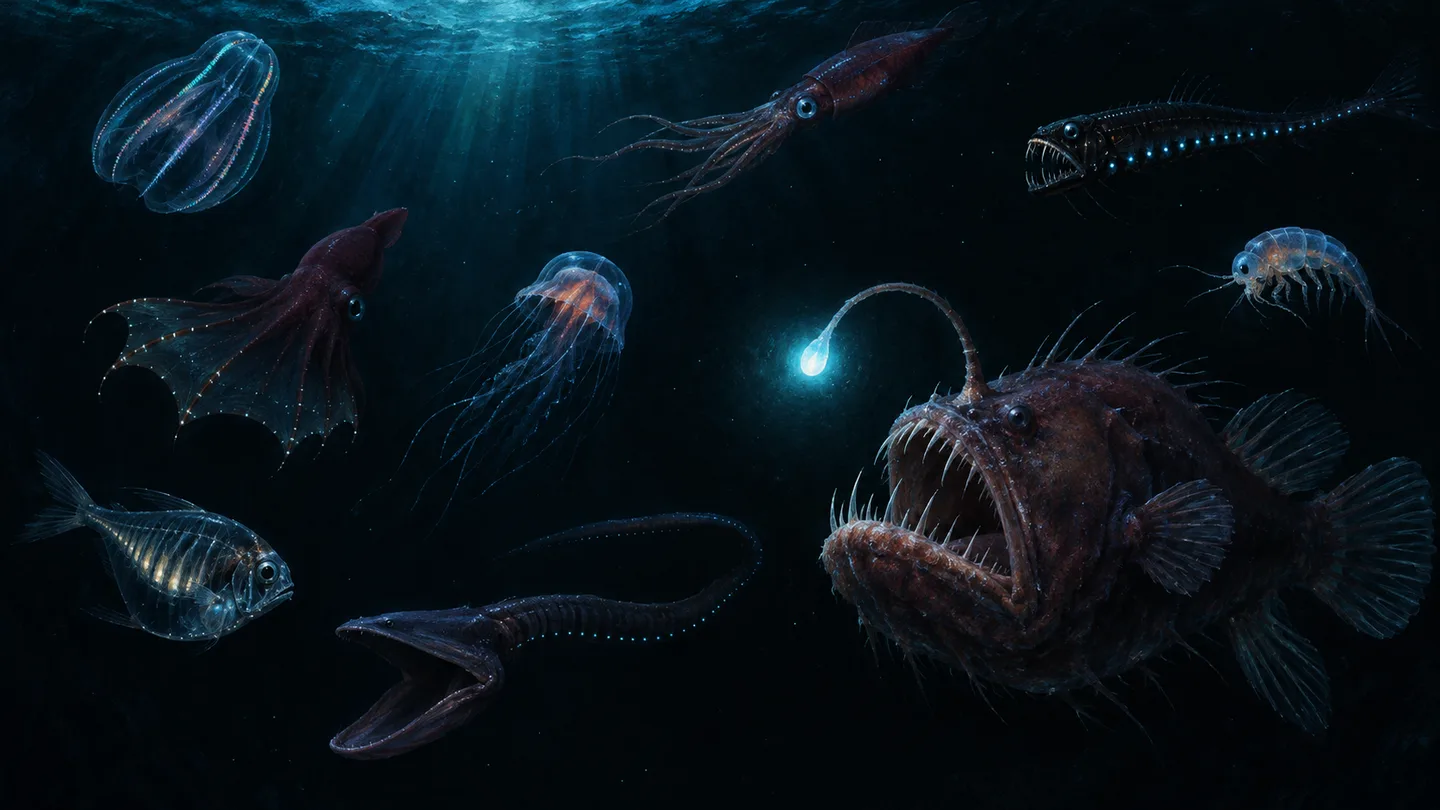
The challenges change with depth
Watch an exploration video from the deep ocean and the first thing you may notice is how much empty water surrounds each animal. The dark backdrop makes a glowing lure or a transparent body stand out. It also hides much of the animal’s environment. Light, pressure and food availability change as you descend, and the depth on the video is one of the most useful clues to what you are seeing.
Different animals solve different combinations of problems. A fish in dim water can still be visible to something looking up from below. An animal living deeper may spend its time in water that receives virtually no sunlight. A bottom dweller has access to a seafloor and the food that accumulates there. A fish in the open water has no such surface to search. Calling all of them deep-sea animals describes a broad setting with many ways to live.
What increasing pressure does to a body
According to NOAA Ocean Exploration, water pressure increases by about one atmosphere for every ten meters of depth. At two thousand meters, the pressure is roughly two hundred atmospheres. The challenge for many animals depends on what is inside them. Gas-filled spaces can change volume as pressure changes. Water in tissues compresses far less. Many deep-sea animals lack the large gas-filled spaces that make pressure changes particularly difficult for organisms at the surface.
Living under pressure still affects the chemistry and physical structure of a body. An animal collected at depth may change appearance or function when brought to the surface. A photograph on deck can therefore tell a different story from a recording taken in the animal’s habitat. If you are comparing two images, check how each was made. Look for a depth reading or a caption saying whether the animal was observed in place or brought aboard.
How animals use light where sunlight fades
Bioluminescence is light produced by living organisms. A light source can attract an animal that might become prey. It can also serve as a signal or as a way to reduce visibility. An anglerfish’s illuminated lure is an easy example to picture. A small moving light sits near the mouth, where a curious animal may come within reach. Other fish use light on the underside of the body. Where a little daylight still filters down, the glow can make a silhouette harder to pick out from below.
An animal’s color matters too. A red body illuminated by a camera lamp can look bright to a viewer, even though red wavelengths from sunlight disappear quickly underwater. Under the ambient light available at depth, that color may appear dark. A scientific camera brings light to the scene, so the color in the footage is partly a consequence of how researchers made the observation.
Finding a meal when prey is scattered
Much of the deep ocean depends on food falling or moving down from more productive waters. The fragments can include dead plankton and other organic material. A large food fall can create a concentrated feeding opportunity on the seafloor. In other locations, chemical energy supports communities around features such as hydrothermal vents. These settings have different food supplies, so the feeding strategies you see can vary even among animals at similar depths.
NOAA’s survey of midnight-zone fishes describes species with large mouths and other features that help them feed when prey is encountered. A large opening can let a predator take advantage of a meal larger than you might expect from the rest of its body. Other animals feed on smaller particles or use sensory systems suited to their surroundings. Look at the jaws, position of the eyes, fins and apparent behavior before drawing a conclusion about how an animal gets food.
Notice where the animal spends its time. A short clip of a fish crossing the camera’s view gives you different evidence from a long observation of an animal feeding at the bottom. The label is a starting point. The sequence and setting tell you which behaviors the observer actually recorded.
What to look for in the next exploration video
Start with three questions. How deep is the camera? Is it looking into open water or at the bottom? Which parts of the scene are lit by the vehicle? Those details can help explain why an animal seems unusually red, still or bright. They can also show why a recording alone may leave some behavior uncertain. Researchers sometimes need repeated observations from different positions to separate an animal’s behavior from the effect of the equipment nearby. KINSMC’s guide to how scientists use two spacecraft to study a distant environment offers a parallel example from space science of why the position of an instrument matters.
Sources
NOAA Ocean Exploration on pressure and animals · NOAA Ocean Exploration on fish of the midnight zone · Smithsonian Ocean guide to the deep sea · NOAA Ocean Exploration on red coloration at depth