 KINSMC
What happened on November 7 and 9
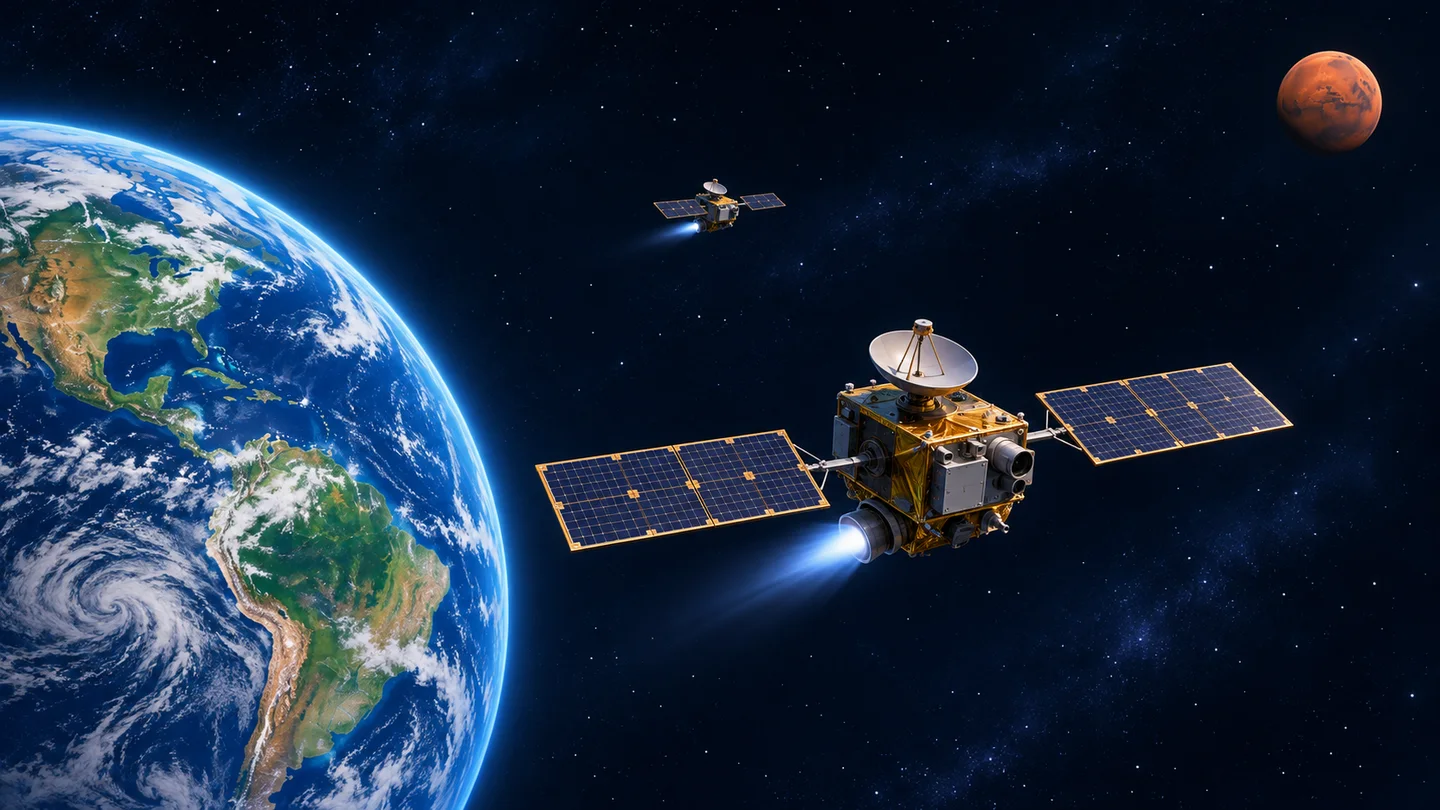
NASA’s twin ESCAPADE probes each swung past Earth and fired their engines near the encounter, sending both spacecraft toward Mars. NASA dates the first closest approach to about 5 a.m. EST on Saturday, November 7, 2026, and the second to about 6 a.m. EST on Monday, November 9. The agency published its confirmation on November 9. It described this as its first use of a powered Earth flyby to send a spacecraft toward Mars.
NASA’s animation marks approximately nine minutes of engine firing for each spacecraft during its trans-Mars injection. The burn and the flyby formed one maneuver. Earth’s gravity curved the path as the propulsion system added a deliberately timed change in velocity. That combination put each probe onto a path NASA expects will take about ten months to reach Mars.
Why did the mission loop back to Earth?
The two spacecraft launched from Florida on November 13, 2025, when NASA says Earth and Mars were on opposite sides of the Sun. A direct transfer depends on the relative positions of the planets. Mars keeps moving throughout the journey, so the useful destination is a future point on its orbit. ESCAPADE’s route separated the day the probes left the launch pad from the day they departed Earth’s neighborhood for Mars.
After launch the spacecraft followed a loitering path around the Sun–Earth L2 region, on the side of Earth that faces away from the Sun. NASA puts L2 about a million miles from Earth and describes the path around it as a broad, kidney-shaped loop. The loop brought the probes back to Earth when the planets were better positioned for the transfer. That gives mission planners a different way to work with launch timing. The flyby geometry and the arrival still have to be designed around a moving solar system.
What does the engine add to a gravity assist?
Picture a spacecraft approaching a moving planet, following a curved path around it and leaving in a new direction. Seen from the planet, gravity pulls the spacecraft inward and bends its path. Seen from the Sun, the planet is moving too, so the new direction of the spacecraft’s motion relative to the planet can change its speed and orbit relative to the Sun. The result depends on the encounter geometry.
A powered flyby also uses the spacecraft’s engine to change its motion. If a burn adds speed where the spacecraft is already moving fast, the same increase in speed can produce a bigger change in orbital energy than it would farther away at lower speed. Mission planners also have to aim the departure correctly. The point is to reach a particular path through space, so a longer or harder burn would be useful only if it helped achieve that trajectory.
In the ESCAPADE case, the Earth encounter was a planned departure step. If you want to compare that with a satellite losing altitude over time, see why satellites fall back to Earth. The story of NASA’s Swift Observatory and its re-entry is a separate example of what orbital decay means for a working mission.
Why send two spacecraft instead of one?
The probes are designed to measure how particles from the Sun interact with the Martian environment and contribute to atmospheric loss. A spacecraft measuring a disturbance by itself may have trouble distinguishing between changes across locations and changes over time. Two spacecraft at different positions can collect measurements during the same interval, giving researchers a way to compare what each saw. Where the probes are relative to each other matters when the team interprets those readings.
The mission is already collecting some data closer to home. NASA reports observations during passes through Earth’s magnetotail, the region of Earth’s magnetic environment stretched away from the Sun by the solar wind. The probes can also study the solar wind during the cruise. Those measurements are separate from the planned study of the Martian environment.
What to watch for next
NASA gives September 7 and 9, 2027, as the planned dates for the two Mars orbit insertion burns. An insertion burn is a new milestone: it is the maneuver intended to place each spacecraft into orbit around Mars. As of NASA’s November 9 update, the confirmed result is that both spacecraft completed their Earth flybys and began the Mars-bound cruise. The arrival maneuvers and formation science are still ahead.
Sources
NASA’s November 9 flyby update · NASA ESCAPADE mission overview