 KINSMC
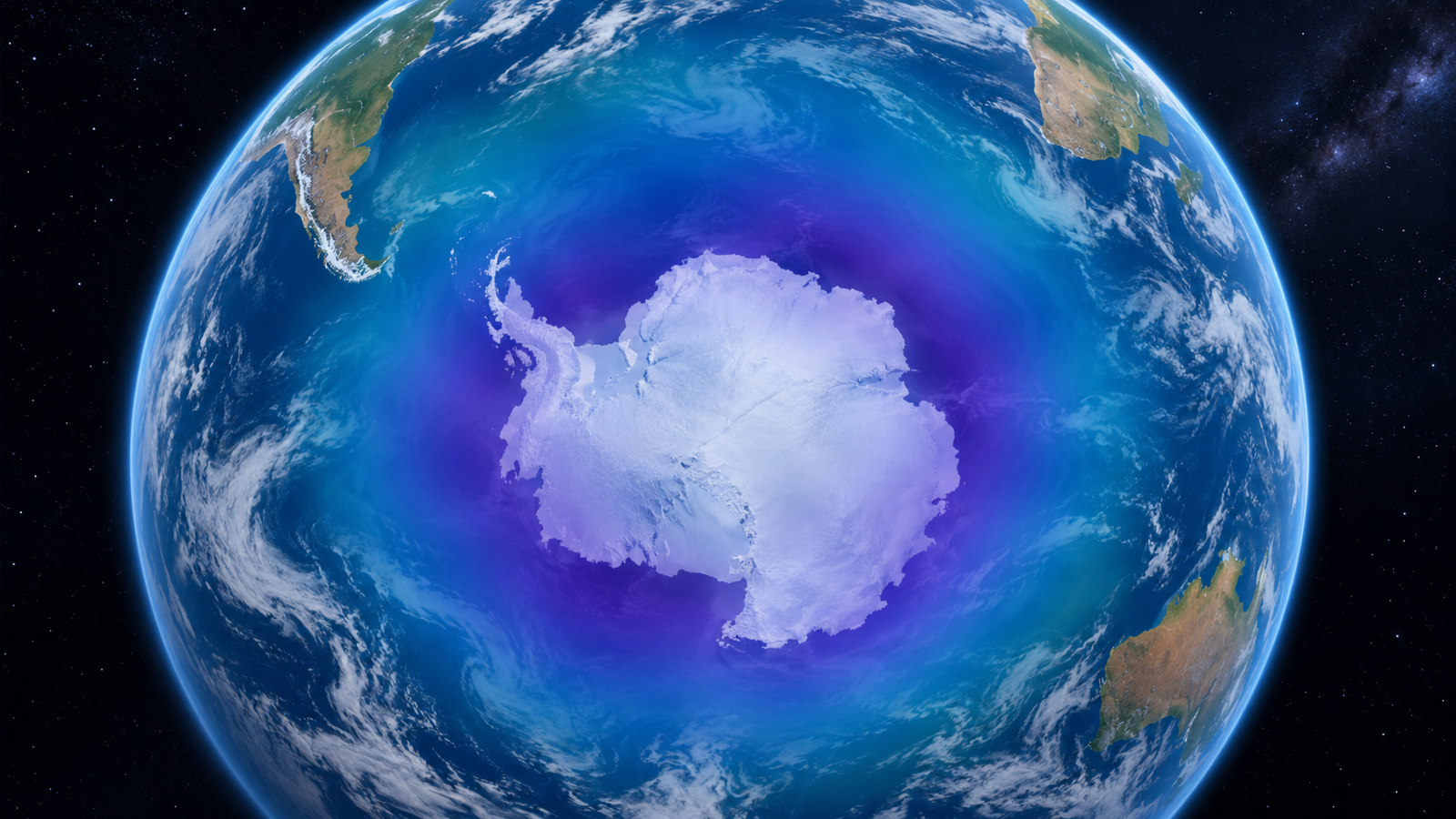
NASA has reported that the Antarctic ozone hole reached its 2026 maximum extent on September 18. The result is notable: when measured by its average area during the main depletion period, the 2026 hole ranked seventh largest in 48 years of observations.
That headline needs context. “Large” can describe the area affected, while “deep” describes how low ozone concentrations become. NASA and NOAA say the 2026 ozone hole was large by area, but not as deep as some other major holes in the satellite-era record. The annual result matters, yet it is not a one-number verdict on whether the ozone layer is recovering.
What NASA measured in 2026
NASA and NOAA track the Antarctic ozone hole using satellites, ground instruments and balloon-borne sensors. For 2026, the agencies report that the hole reached its greatest one-day extent on September 18, covering about 10.5 million square miles (27.1 million square kilometres).
For the seasonal measure, scientists looked at its average extent between September 7 and October 13, when Antarctic ozone depletion is usually strongest. Over that interval, the hole averaged about 9.6 million square miles (25 million square kilometres). By this measure, it was the seventh largest observed since regular monitoring began in 1979.
The measurements do not describe a literal gap in the atmosphere. “Ozone hole” refers to a region where ozone concentrations fall below 220 Dobson units, the scientific threshold used to map unusually depleted ozone over Antarctica.
Why area and depth are different
It is tempting to treat “largest” as meaning “worst,” but ozone scientists use more than one metric. Area shows how much of the Antarctic stratosphere falls below the ozone-hole threshold. Depth describes how low the ozone concentration becomes within the depleted region.
NASA notes that records for maximum area and maximum depth have not occurred in the same year. That distinction helps explain the 2026 result. The hole covered a relatively large area, but it was not as deep as several earlier large ozone holes.
NOAA’s South Pole observations found that the lowest overhead ozone reading in 2026 was 105 Dobson units on October 17. That is extremely low compared with normal atmospheric ozone levels, but above the record low of 92 Dobson units observed over the South Pole in October 2006.
The useful lesson is simple: annual ozone updates should be compared across both area and depth, rather than reduced to a single ranking.
Why the 2026 hole grew so large
NASA and NOAA point to weather conditions high above Antarctica as a major part of the explanation. The Antarctic polar vortex, a seasonal band of strong winds that isolates very cold air over the continent, was unusually powerful in 2026.
Cold stratospheric conditions support chemical reactions that destroy ozone. Chlorine- and bromine-containing compounds produced by people can remain in the atmosphere for decades. In the cold Antarctic stratosphere, they can be converted into forms that react rapidly with ozone after sunlight returns in spring.
According to NOAA, planetary-scale weather systems that normally help disrupt the vortex were especially weak in August and September. The vortex remained large and cold, increasing the area where conditions favored ozone depletion.
This is why a single season does not erase the wider trend. Year-to-year changes in temperature, winds and circulation can substantially alter the size and depth of the ozone hole even while the underlying amount of ozone-depleting substances declines.
Does a large 2026 hole mean recovery has stopped?
No. NASA and NOAA continue to describe the ozone layer as being on a path toward long-term recovery, while stressing that recovery will not look identical every year.
The Montreal Protocol, agreed in 1987, phased down production and consumption of major ozone-depleting substances. NASA and NOAA report that chlorine in the Antarctic stratosphere derived from such substances has fallen by about one-third from its peak relative to 1980s levels.
The agencies estimate that Antarctic ozone could return to 1980 levels in the 2070s if the recovery path continues. That is a long-term scientific projection, not a promise that every Antarctic spring will produce a smaller ozone hole than the previous one.
NASA also notes that the annual hole has been forming later in recent years, one sign researchers consider while evaluating recovery. The 2026 season shows why continuous observation still matters: weather can temporarily produce a large ozone hole even as the underlying chemicals decline.
How to read future ozone-hole headlines
When a new annual ozone result appears, ask four questions:
- Is the headline referring to maximum daily area or seasonal average area?
- How deep was the ozone depletion, not just how broad was it?
- Were unusual polar-vortex conditions involved?
- Is the claim about one season, or the long-term recovery trend?
The 2026 update has a clear answer to each. It was a large Antarctic ozone hole by area, shaped by an unusually strong polar vortex, but not among the deepest on record. The longer story is one of atmospheric chemistry and gradual recovery that must be judged across decades rather than a single spring.
For another NASA science explainer, read why NASA’s PROMISE Moon rover needs nuclear power at the lunar south pole.
Sources
- NASA Earth Observatory: Ozone Hole Reaches Its 2026 Maximum
- NASA Science: NASA, NOAA Track 2026 Antarctic Ozone Hole
- NOAA: 2026 ozone-hole measurements