 KINSMC
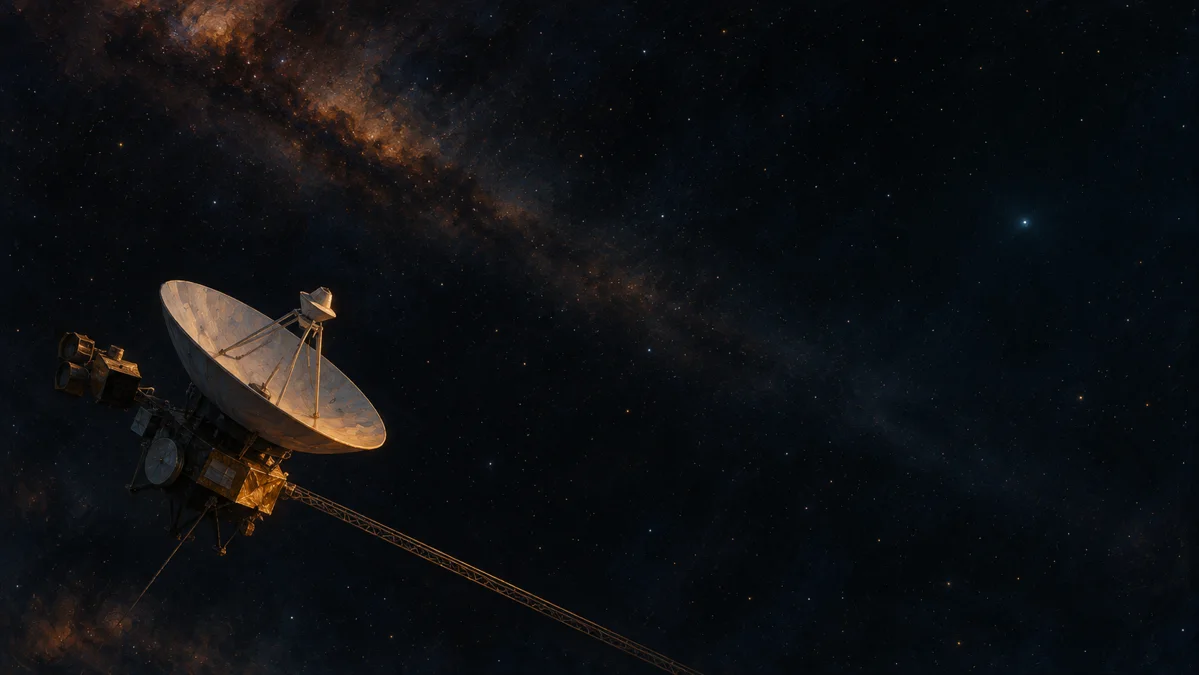
A message sent to Voyager 1 can spend an entire day in transit. If the spacecraft could answer immediately, the reply would spend about another day on its way back. NASA projects that Voyager 1 will be one light-day from Earth on November 18, 2026, at 5:16 a.m. EST (10:16 a.m. GMT). Here is what that milestone tells you about distance, radio communication and the view of the spacecraft scientists get on Earth.
How far is one light-day?
A light-day is the distance light travels in a vacuum in 24 hours, about 16.1 billion miles or 25.9 billion kilometres. To get the distance, multiply roughly 300,000 kilometres per second by the 86,400 seconds in a day. The result is a convenient way of expressing a very large number. The same unit also tells you the approximate travel time of a radio signal sent across that distance, because radio waves and visible light are both forms of electromagnetic radiation.
NASA’s timestamp describes when the mission expects the Earth-to-spacecraft distance to cross that threshold. Treat the time as a mission estimate. Both Earth and Voyager are moving, and the distance on NASA’s tracker refers to their separation at a given time. The spacecraft keeps moving through interstellar space as the number changes. The unit measures its distance from Earth at the milestone, which is different from the total length of the route it has flown.
Why a reply takes about two days
Imagine an Earth antenna transmitting a short command at noon on Monday, with the probe about one light-day away throughout the exchange. The command would arrive around noon Tuesday. If the spacecraft immediately transmitted a response, Earth would receive that response around noon Wednesday. In practice, the reply could come later. A command can take time to execute, the spacecraft may transmit data on a schedule, and a ground station must be available and listening when the signal arrives.
The two-day figure describes a round trip. If the spacecraft sends a scheduled reading without waiting for a command from Earth, that single transmission takes about a day to arrive. When you see a mission update posted on a Wednesday, the reading could describe conditions on Tuesday. The date on the update, the time of reception and the time an instrument took a measurement answer different questions.
Why a bigger dish cannot make the signal arrive sooner
Light-travel time sets the delay. Receiving the signal presents a separate problem. Radio energy spreads across space, and only a tiny fraction reaches the receiving antenna. Large ground dishes help collect that faint signal, and the spacecraft’s directional antenna helps concentrate its transmission towards Earth. A better receiving setup can help engineers distinguish a transmission from noise. The speed at which it crosses space stays the same.
Data rate is separate again. A short status message and a longer stream of measurements both begin crossing space at about the same speed. The longer transmission can take more time to finish sending and receiving. Think of three questions when you read that a signal is slow: how long the first bit takes to get here, how much data arrives per second, and when operators have a chance to listen. The one-light-day milestone answers the first question.
How Voyager can be decades old and one light-day away
Voyager 1 launched in 1977 and used encounters with giant planets on its way out of the solar system. A radio transmission covers in one day a separation the spacecraft has taken decades to reach. The comparison is about the speed of a signal versus the speed and path of a spacecraft. For a newer example of how a mission’s route can use a planet’s motion and gravity, see our guide to how NASA’s ESCAPADE probes used Earth to head to Mars.
The scale changes dramatically even within the solar system. Light takes about 1.3 seconds to cross the average Earth–Moon distance and about eight minutes and 20 seconds to get from the Sun to Earth. Radio travel time to Mars changes as the two planets move around the Sun. At Voyager 1’s milestone, the same physics produces a wait measured in days for a conversation.
How to read the mission tracker
Look for one-way light time alongside the distance in miles or kilometres. It gives you a direct estimate for an incoming signal. For a rough command-and-reply estimate, double it, then remember the operational delays. That simple distinction explains why a NASA team can send an instruction today and still be waiting for the spacecraft’s answer tomorrow.
For the planned milestone and the current distance, see NASA’s light-day explainer and the Voyager distance tracker. NASA also publishes a worked example of the one-way and round-trip calculations.