 KINSMC
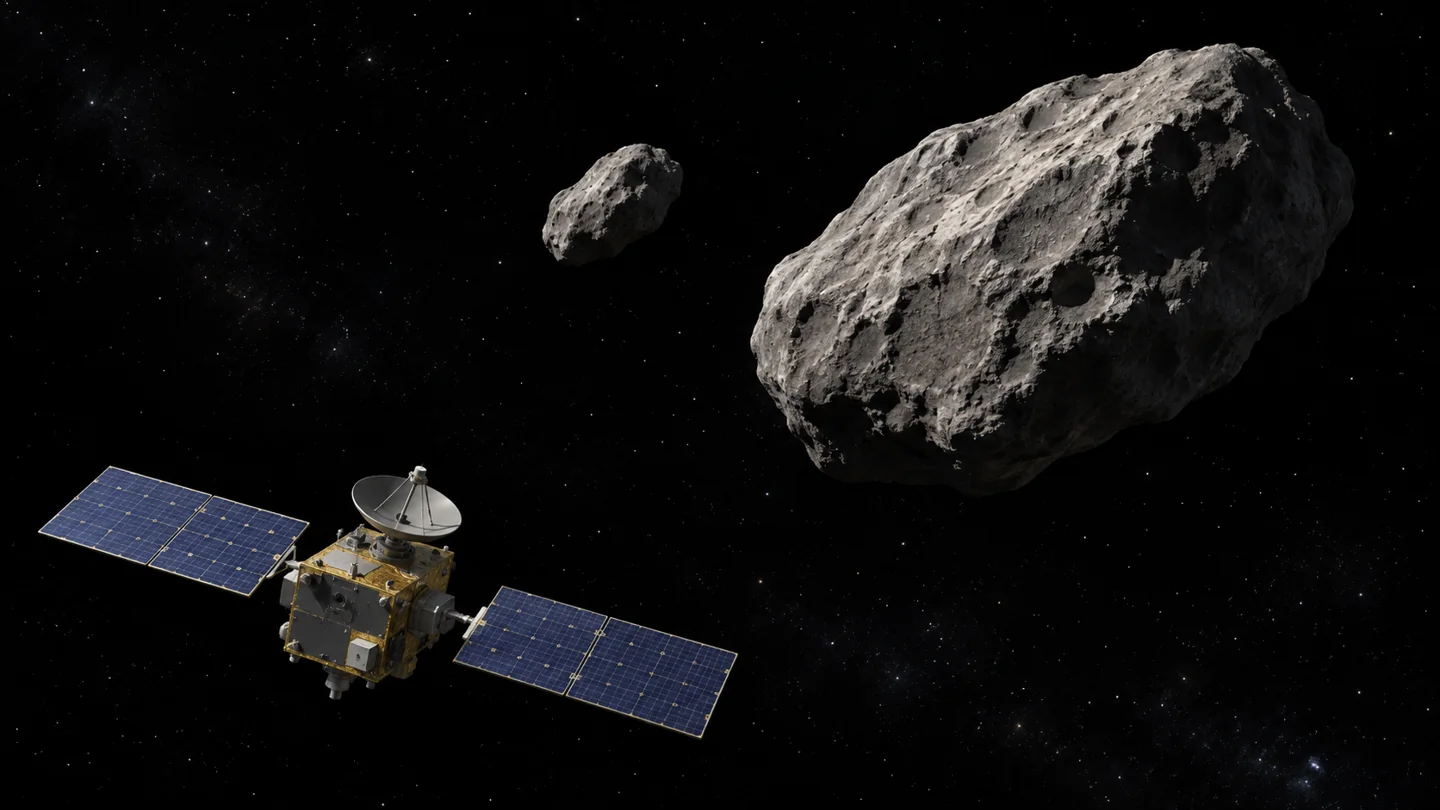
A spacecraft flying around an asteroid can have more in common with a slow-moving survey vehicle than a satellite circling Earth. On November 11, the European Space Agency reported that Hera had begun an early survey of Didymos and its smaller companion, Dimorphos. The flight team is keeping Hera roughly 25 to 30 kilometers from the pair while it takes in the broader scene. The date marks ESA’s update. The agency did not give a precise start time for the survey in that report.
What ESA means by a rectangular orbit
Gravity changes a moving spacecraft’s direction. Around Earth, that steady change can keep a satellite following a curved path. At Hera’s working distance, the two asteroids exert far less gravitational pull than a planet. ESA’s solution during this phase is to let Hera travel along nearly straight stretches and then use its thrusters to change course by about 90 degrees. The turns come on alternating intervals of three and four days. The shape describes the route traced relative to the two asteroids.
Hera flies around the pair’s common center of gravity at about 12 centimeters per second, or roughly 430 meters per hour. Think of the flight plan as a series of departures with carefully scheduled turns. The slow speed gives the mission team time to monitor the approach, and small burns can send the spacecraft onto its next leg. The distance of 25 to 30 kilometers describes Hera’s separation from the asteroids during the survey, rather than the length of a leg.
The two bodies are also very different in size. ESA gives Didymos a diameter of about 780 meters and Dimorphos about 151 meters. When a mission update says Hera is surveying both, it means the spacecraft is collecting information about the larger body and the smaller moonlet that circles it. A pass that gives a useful view of one face can leave other terrain for another pass. Read the November update as the beginning of a survey whose coverage will build over time.
Why a missed turn would send Hera away
ESA says the path is set up so that if an individual turn burn fails, Hera would drift away from the asteroids. A useful way to picture that is to draw an arrow along one edge of the route. At the corner, extend the arrow straight ahead. The turn is what sends the spacecraft along the next side. Without it, continuing on the original heading takes Hera outward. The flight plan gives the team a chance to respond to a failed burn while the spacecraft gains distance.
That use of propulsion differs from the maneuver in our explainer on how NASA’s ESCAPADE probes used Earth to head to Mars. The Mars probes fired engines during an Earth flyby to change a much larger trajectory. Here, the burns keep a spacecraft in a useful viewing area around two small bodies. The same basic action changes a spacecraft’s speed or heading, with different consequences depending on the surrounding gravity and the flight plan.
What is known about DART and what Hera will measure
NASA’s DART mission struck Dimorphos on September 26, 2022. NASA reports that the collision shortened the smaller asteroid’s orbit around Didymos by about 33 minutes. That period change is an observed result of the test. The shape of the impact site, the internal structure of Dimorphos and the role its mass played in the outcome are still questions for the follow-up survey. A new image can show surface features while leaving open how deep those features go or how they formed. NASA’s DART target overview explains how the pair was used to measure the change.
ESA expects Hera to begin a closer survey in December, using arcs that start at around 20 kilometers. Treat that as the agency’s plan as of November 11. In a later update, look for measurements that narrow the uncertainty about the asteroid itself. Scientists can then use those observations alongside the measured orbital change to evaluate which impact models best describe what happened.