 KINSMC
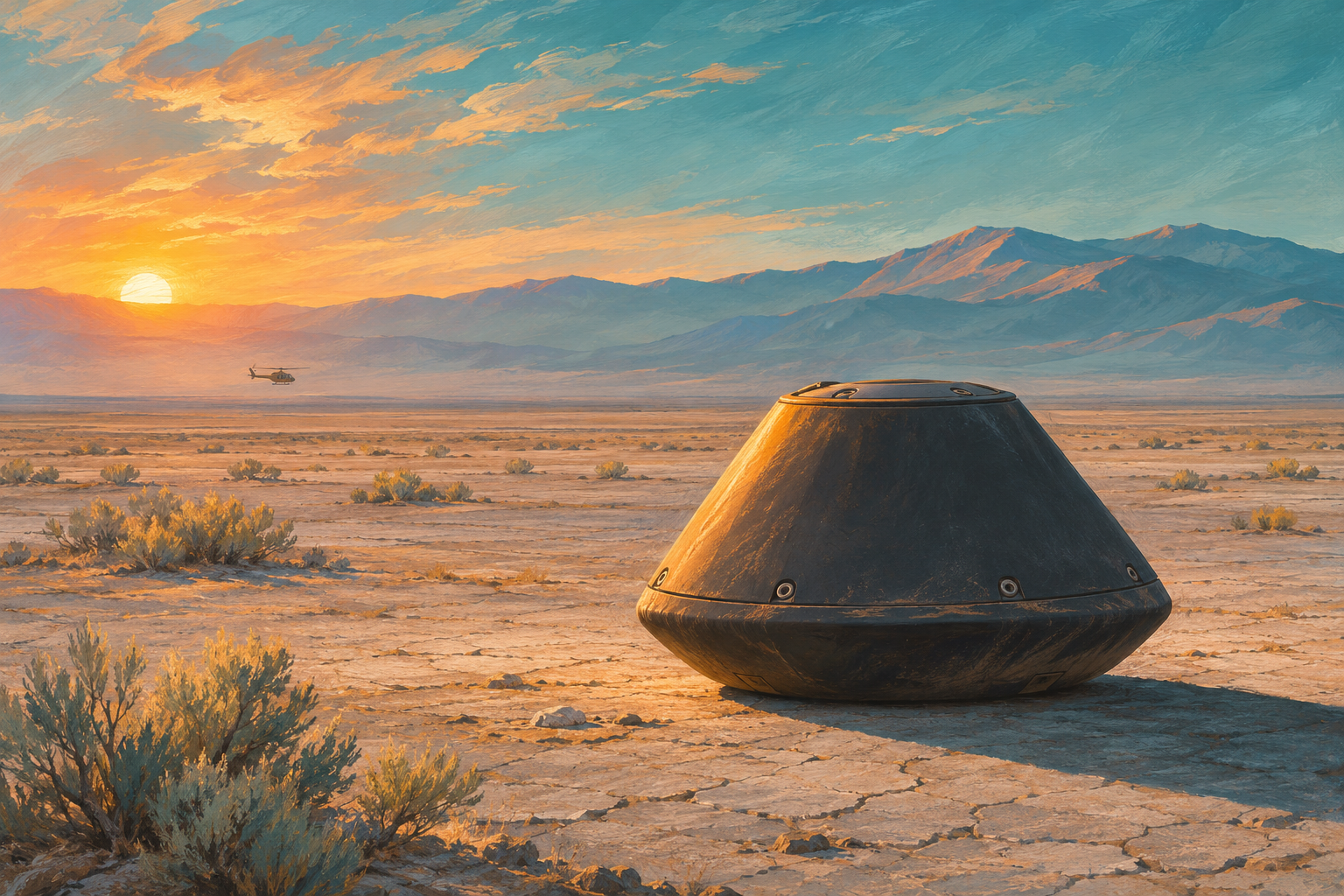
In brief: NASA’s OSIRIS-REx sample-return capsule landed at the Utah Test and Training Range on 24 September 2023, at 8:52am Mountain Daylight Time, or 10:52am Eastern Daylight Time. The capsule brought rocks and dust from asteroid Bennu. The larger spacecraft did not land: it released the capsule and continued into space. This is a retrospective guide to the completed return, not an announcement of a new landing.
If you have found an old headline asking when OSIRIS-REx will land, the important update is that the return already happened. Several different moments appear in mission coverage: departure from the asteroid, release of the capsule, atmospheric entry, touchdown and delivery to a laboratory. Understanding which event a time refers to makes the story much easier to follow.
When and where did the capsule land?
NASA’s 24 September 2023 landing announcement records touchdown at 8:52am MDT in a designated part of the Department of Defense’s Utah Test and Training Range, near Salt Lake City. That is 14:52 UTC and 3:52pm British Summer Time on that date. These are equivalent times for the actual event, not a future viewing schedule.
A useful way to read a mission timeline is to put the event name next to every time. A broadcast can begin before entry; a capsule can touch down before a recovery team reaches it. A headline that omits those distinctions may appear inconsistent with another report even when both are describing different stages correctly.
Why only part of the spacecraft returned
The NASA mission history distinguishes the sample-return capsule from the spacecraft that carried it. The capsule was the part designed to bring the collected material through Earth’s atmosphere. Saying that “OSIRIS-REx landed” is convenient shorthand, but it can wrongly suggest the entire spacecraft came down in Utah.
After the release, the larger spacecraft diverted away from Earth. NASA describes its follow-on mission under the name OSIRIS-APEX. When reading a later article, first identify which name, vehicle and event it discusses. A future encounter involving that spacecraft should not be confused with a second Bennu-sample landing.
How Bennu’s material reached Earth
NASA’s history places the main milestones in a clear sequence: launch in September 2016, arrival at Bennu in December 2018, collection in October 2020 and departure for Earth in May 2021. The September 2023 delivery therefore concluded a journey with long periods of navigation, observation and preparation between its most visible moments.
Put those milestones on separate lines when explaining the mission to a student or building a personal research note. Beside each, write what changed: the spacecraft left Earth, reached its target, collected material, began the return journey or delivered the capsule. This original note-taking exercise helps prevent collection day and return day from becoming merged into a single event.
For the return itself, NASA’s capsule-release update records release at 6:42am EDT on 24 September. The later landing announcement records entry and touchdown separately. Use the final event report for the observed touchdown time instead of copying a pre-event estimate from an older preview.
What happened immediately after touchdown?
According to NASA’s OSIRIS-REx FAQ, specialists inspected and recovered the capsule, moved it to a temporary clean room and used a flow of nitrogen to help protect its contents from terrestrial contamination. The unopened canister was transported to NASA’s Johnson Space Center in Houston on 25 September 2023.
The point of that careful handling was scientific. If a laboratory detects a molecule, researchers need confidence about where it came from. Material introduced during collection, transport or handling could complicate that interpretation. A successful landing was therefore one step in a longer evidence chain, rather than the moment at which every scientific question about the asteroid was answered.
Why bring a sample home instead of relying on images?
NASA selected Bennu partly because its material can preserve clues about the early solar system. Samples let researchers investigate physical material in laboratories, alongside the observations made by the spacecraft. Those are complementary sources of evidence: pictures describe a landscape, while an analysed grain can answer a more specific question about the material within it.
Keep the question and the measurement together when reading later research. A finding about a mineral, an organic compound or an inferred past environment is not automatically evidence that an organism existed on Bennu. Check what the researchers measured and what they concluded before repeating the broadest version of a headline.
This distinction between observation and interpretation also matters in more familiar astronomy. Our guide to supermoons separates a visible event from the impression its name can create. And the Perseid observing guide concerns watching natural sky events, which is different from following a controlled sample-return operation.
How to check an old landing headline
First, read the publication date and identify whether the report is a preview or a record of an event that has happened. Next, check whether the time is local, UTC or a broadcast start. Finally, compare the claim with NASA’s mission history or event report. Keep a short source note containing the event date, location, vehicle involved and the link you used.
For a school presentation, one clear sentence can carry the essential answer: a capsule containing Bennu material landed in Utah on 24 September 2023, while the main spacecraft continued into space. Add the recovery and laboratory stages only after that distinction is clear. There is no need to turn a completed historical event into a new prediction.
Sources and editorial review
Reviewed 28 November 2026 using the linked NASA landing announcement, capsule-release update, mission history and FAQ. Historical landing facts are distinguished from later science and future mission planning. Time-zone equivalents are editorial conversions for 24 September 2023. No new scientific discovery or live mission status is asserted. The featured image is an original AI-generated concept illustration, not an image of the actual recovery.