 KINSMC
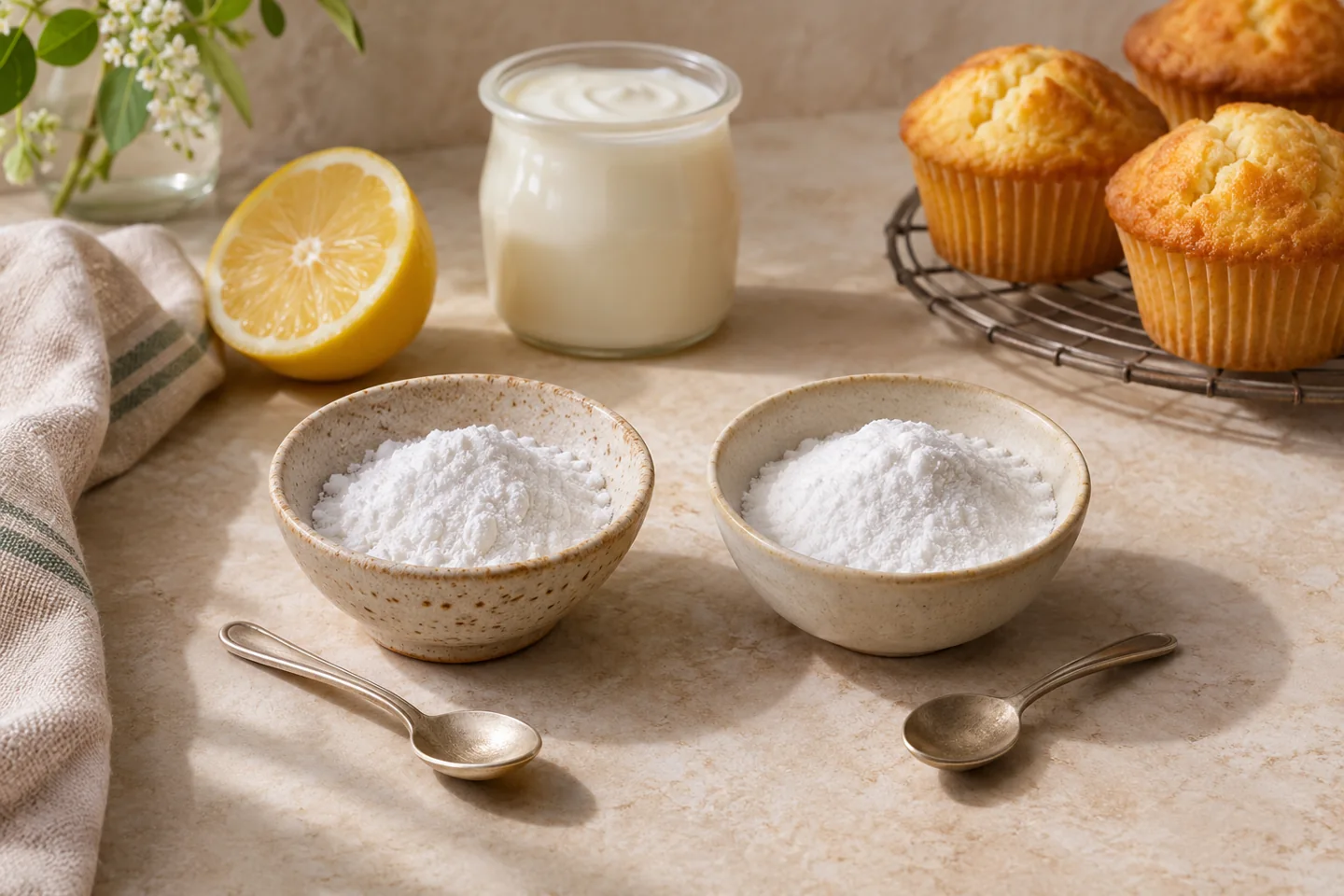
Baking soda is sodium bicarbonate, an alkaline ingredient that reacts with acids. Baking powder contains bicarbonate plus acid ingredients, so it can supply leavening without a separate acidic ingredient in the recipe. Both can release carbon dioxide that expands the bubbles in a batter. They are not interchangeable spoon for spoon, because they also change acidity, flavour and browning.
The useful question is not which one is stronger or better. It is what the recipe needs: gas, a change in acidity, or both. Understanding that distinction helps explain why pancakes can taste soapy, why a cake can rise and then collapse, and why a recipe sometimes asks for two different white powders.
Baking soda and baking powder at a glance
| Feature | Baking soda | Baking powder |
|---|---|---|
| Main ingredients | Sodium bicarbonate | Bicarbonate, acid ingredients and usually starch |
| What activates it | Moisture and an available acid; heat also affects it | Moisture, with further gas release from heat in double-acting products |
| Effect on acidity | Neutralises some of the recipe’s acid | Designed with its own acid–base balance |
| Common mistake | Adding more without enough acid | Assuming more powder always produces more height |
| Substitution | Requires attention to the whole recipe | Not a one-for-one replacement for soda |
What makes baked food rise?
A cake does not rise simply because a chemical produces gas. Mixing introduces tiny pockets of air, and carbon dioxide and water vapour help expand those pockets. Meanwhile, starch and proteins change as the batter heats, eventually forming a structure firm enough to hold the expanded shape. Gas production and structural setting have to work together.
This is why a very wet batter, an unsuitable pan or an oven that is not properly heated can cause trouble even when the leavener is fresh. If gas expands before the surrounding material can support it, bubbles may merge and escape. A dramatic rise followed by a sunken centre is therefore not proof that the recipe needed more baking powder.
Different foods also use different sources of lift. Yeast produces gas through fermentation; whipped eggs introduce a foam; laminated pastry relies heavily on steam between layers. Chemical leaveners are only one part of the larger baking system. Adding them to a recipe designed around another system can change the intended texture.
What baking soda does besides making bubbles
Acids such as those in cultured dairy, citrus juice and some other ingredients react with bicarbonate when enough moisture is present. The reaction releases carbon dioxide and changes the mixture’s acidity. The amount of usable acid differs between ingredients and products, so replacing one acidic ingredient with another is more complicated than matching their volumes.
Reducing acidity can alter flavour and encourage browning. That can be desirable in a particular cookie or pancake recipe, but excess soda may leave an unpleasant alkaline, bitter or soapy taste. A darker crust does not automatically mean a baked item is fully cooked inside. Colour is a useful observation, not a substitute for the recipe’s doneness checks.
Natural cocoa and alkalised cocoa illustrate why ingredient details matter. They have different acid characteristics. If you change the type of cocoa in a recipe that relies on soda, the recipe’s original balance may no longer apply. The same caution is useful when replacing cultured dairy with a neutral liquid: the change affects more than moisture.
What “double-acting” baking powder means
Double-acting baking powder is formulated to release gas in stages: some when the ingredients become wet, with additional action during heating. This gives the batter a different timing pattern from a simple mixture of soda and a readily reacting acid. The exact behaviour depends on the acids used by the manufacturer.
The starch in the container helps keep the ingredients dry and separate during storage. It is not there to provide the same function as the flour in your cake. Moisture entering the container can start reactions prematurely, which is one reason to use a dry measuring spoon and replace the lid promptly.
Double-acting does not mean a batter can wait indefinitely without consequences. Bubbles can still escape, flour can continue absorbing liquid, and other ingredients can change while it stands. Prepare the pan and preheat the oven before combining wet and dry ingredients when the recipe calls for immediate baking.
Why some recipes use both
A recipe may need enough soda to neutralise part of an acidic ingredient, while still needing more lift than that reaction supplies. Baking powder can contribute the additional gas without requiring a large further change in acidity. The developer may also want to preserve some tang rather than neutralise every available acid.
For example, the purpose of cultured dairy in a batter may include flavour, tenderness and moisture as well as acid. Removing it or increasing soda can change several qualities at once. Treat the two leaveners as separate ingredients with separate jobs instead of assuming the recipe contains an accidental duplication.
Can you substitute one for the other?
Sometimes, but a dependable substitution has to account for the recipe’s acid, liquid and intended texture. Baking powder contains other ingredients besides bicarbonate, so the same spoonful does not provide the same chemical amount. Adding extra soda to compensate for missing powder can leave unused alkali behind.
The most reliable options are to use a substitution tested for that particular recipe or choose a recipe written for the leavener you have. This matters especially for large cakes and celebration bakes, where an untested adjustment can waste considerably more ingredients than a small trial batch.
Do not substitute baking soda with washing soda or other household cleaning powders. Use a clearly labelled food ingredient. Also check whether a flour is self-raising or self-rising: it already contains a leavening system, and adding a recipe’s full separate quantity without adjustment can produce too much lift.
Troubleshoot the result before changing the quantity
- Soapy or bitter flavour: check the measured amount of soda, the acidic ingredient and any substitutions. More sweetness may conceal some flavour but does not correct the chemistry.
- Dense, flat texture: check freshness, measurement, mixing, pan size and oven preparation. Weak leavening is one possible explanation, not the only one.
- Coarse holes or a collapsed centre: review excessive leavener, overfilling, batter structure and underbaking before increasing anything.
- Uneven pockets of flavour: disperse the dry leavener thoroughly through the flour rather than leaving concentrated lumps.
- Different results after a substitution: restore the original ingredients once before changing several other variables.
A practical measuring and storage routine
Read the ingredient name twice, since similar packaging makes confusion easy. Use a level measuring spoon of the size specified; an ordinary eating spoon is not a dependable equivalent. If a recipe provides a weight, use a scale capable of measuring small quantities accurately. Weighing on a scale that barely registers a few grams can be less useful than a correct measuring spoon.
Keep containers tightly closed in a dry cupboard, away from steam. Note the opening date if you bake infrequently. A simple fizz test can suggest that an ingredient still reacts, but it cannot reproduce the balance, timing and structure of your actual batter. Replace an uncertain old container before a bake where failure would be costly.
When investigating repeated problems, write down the brand, amounts, pan dimensions and substitutions. Change one variable at a time. That makes the next result informative instead of creating a new recipe with several possible explanations for every difference.
Common questions
Is bicarbonate of soda the same as baking soda?
Yes. These are common names for food-grade sodium bicarbonate. Baking powder is a different product containing a formulated combination of ingredients.
Does more baking powder make a cake fluffier?
Only within the balance of the recipe. Too much gas can create a coarse texture or a rise that the structure cannot hold. More is not a dependable repair for a dense cake.
Can I leave out the leavener?
Expect a different result unless the recipe was designed to rise through another method. A thin cookie may tolerate a change differently from a deep cake, but omission is still a recipe modification.
Sources and further reading
This explanation draws on Harold McGee, On Food and Cooking, second edition (2004), sections on chemical leavening and baked foods. For a practical discussion of substitutions, see King Arthur Baking’s guide to baking soda and baking powder. For another ingredient-label skill, read our guide to added sugar and total sugar.
Prepared with AI assistance from the cited sources. This is an ingredient explainer, not a separately kitchen-tested recipe. Featured image: AI-generated illustration.