 KINSMC
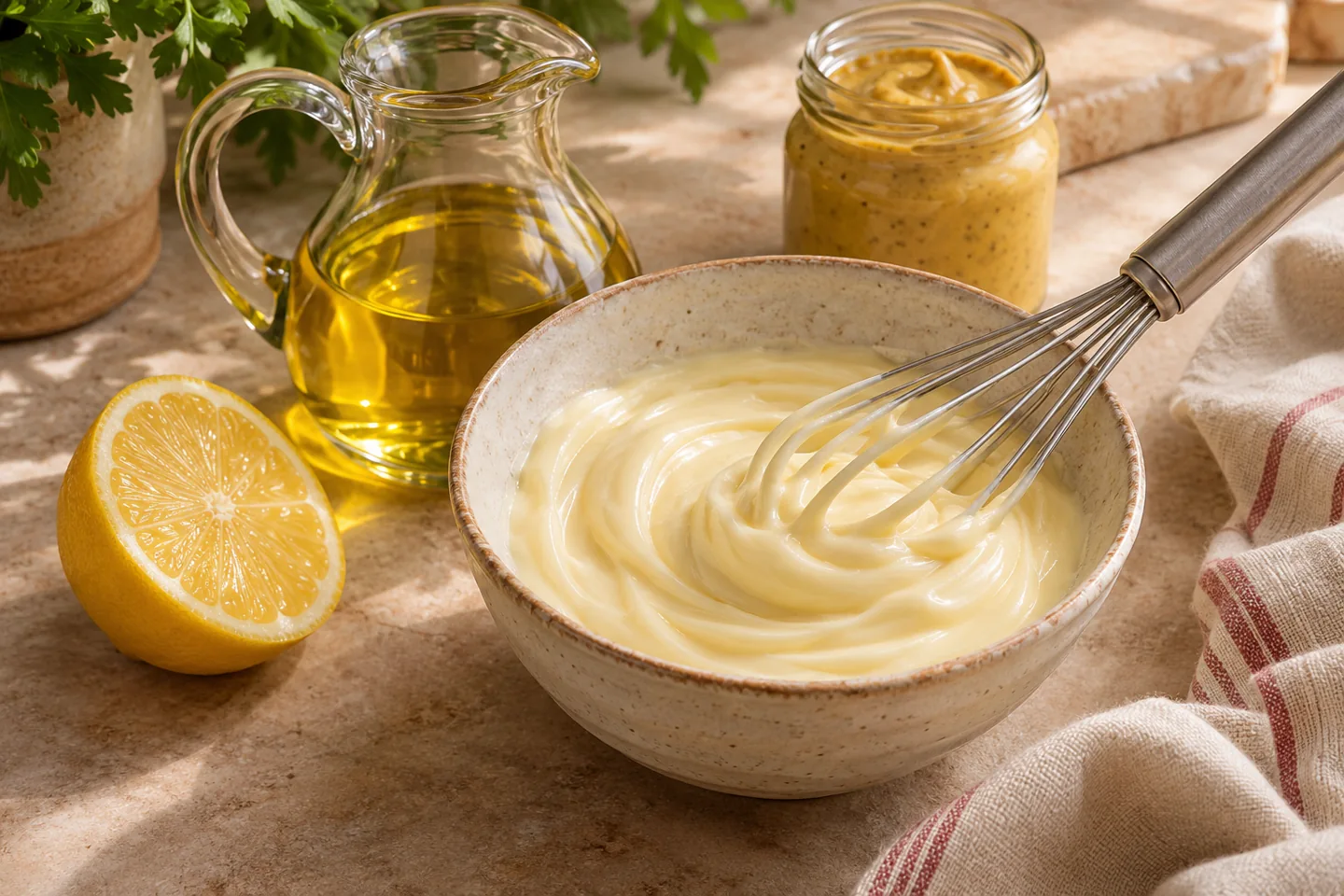
Mayonnaise splits when its oil droplets join together instead of staying dispersed in the watery part of the sauce. Adding oil too quickly at the start, having too little water available, or exposing the finished emulsion to unsuitable temperatures can contribute. A separated batch can often be incorporated slowly into a fresh base, provided the ingredients and handling are safe.
Texture and food safety need separate decisions. A smooth mayonnaise made with untreated raw egg is not automatically safe, and a rescue cannot undo unsafe time or temperature exposure. For a homemade uncooked egg mayonnaise, use pasteurised eggs or pasteurised egg products suitable for the recipe.
What a mayonnaise emulsion is
Oil and water do not normally remain evenly mixed. Mayonnaise makes them cooperate by dividing oil into many tiny droplets distributed through a continuous watery phase. Egg yolk contributes substances that help coat and stabilise those droplets; mustard can also help a formulation remain dispersed.
Whisking or blending supplies the mechanical work that breaks the oil into droplets. The recipe’s emulsifying ingredients then help prevent those droplets from immediately joining again. A thick sauce develops as the droplets become crowded while still remaining separate from one another.
This explains why mayonnaise contains more than oil and egg in a practical sense. Water within the egg and other ingredients is part of the structure. Lemon juice, vinegar or added water may contribute to that continuous phase as well as changing flavour. Omitting a liquid because it seems like “just seasoning” can alter the system.
Recognise a split sauce
| Observation | Possible explanation | Useful response |
|---|---|---|
| Oil pools around a loose mixture | Oil has not stayed dispersed | Stop adding oil and rebuild the emulsion gradually |
| Smooth but thinner than expected | The recipe’s oil-to-liquid balance or mixing stage | Check the recipe before treating it as broken |
| Very thick and difficult to whisk | Droplets are tightly crowded | Follow the recipe’s liquid adjustment rather than forcing in more oil |
| Separation after freezing | Freezing has disrupted the emulsion | Do not assume thawing restores the original texture |
Thin mayonnaise is not always split mayonnaise. A smooth, uniformly coloured sauce can simply have a different balance of oil and liquid. Look for visible separation and consider the stage of the method before applying a remedy intended for a broken emulsion.
Why the first oil additions matter
At the beginning, a relatively small amount of watery base must receive and stabilise the oil you add. Pouring in a large quantity can overwhelm the mixing process before a fine dispersion has formed. Oil then collects faster than the whisk can divide and distribute it.
With a traditional whisking method, begin with small additions and make each one disappear into the base before adding more. Once the emulsion is established, the method may allow a steadier stream. Keep following the recipe rather than interpreting a successful first minute as permission to empty the bottle at once.
Some immersion-blender recipes deliberately start with ingredients layered in a narrow vessel. Their success depends on vessel dimensions, blade position and the way oil is drawn into the base. Do not combine the ingredient sequence of one method with the equipment technique of another and expect the same reliability.
Choose equipment that actually reaches the mixture
A small amount of yolk and liquid in a very wide bowl can spread into a shallow film that is awkward to whisk. A large blender may also struggle with a batch below its effective working volume. Match the vessel and quantity to the method so the tool moves the ingredients efficiently.
Secure the bowl with a damp towel underneath if needed, keeping that towel outside the food. Having both hands available for controlled pouring and whisking makes a gradual addition easier. Measure ingredients first so you do not pause halfway through to find the vinegar.
For a stick blender, use the vessel and batch size specified by a trustworthy recipe. Moving the head too early in a method that relies on emulsifying the bottom layer can draw in oil before the base is ready. Equipment-specific instructions are functional, not decorative details.
How to rebuild a broken mayonnaise
First, stop adding oil. If the mixture has been handled safely and remains suitable to use, prepare a small fresh base according to a reliable mayonnaise recipe, using pasteurised egg where egg is required. In a clean bowl, establish that base before introducing the broken mixture.
Add the separated batch a little at a time while whisking or blending as the method directs. Treat it as the oil-rich ingredient you are incorporating, rather than pouring the entire failed batch into the new base. Wait for each addition to become smooth before continuing.
If the sauce becomes extremely thick, follow the recipe’s instructions for adding a little appropriate liquid. Do not keep increasing the oil simply because the mixture looks substantial. A functioning emulsion still needs enough continuous watery phase around its droplets.
This approach changes the final amount and composition. Taste and adjust seasoning only after the texture is stable, and keep track of what you added. Do not promise an exact yield or acidity from a rescue assembled by eye.
What lemon juice and vinegar can—and cannot—do
Acid ingredients give mayonnaise its characteristic tang and affect its chemistry. Their water also contributes to the liquid phase. However, a squeeze of lemon does not prove that a homemade raw-egg sauce has reached a safe acidity throughout.
Lemon juice, different vinegars and different recipes vary. Food safety cannot be inferred from how sour the sauce tastes. Use pasteurised egg for an uncooked preparation and a reliable recipe with appropriate handling instructions; do not treat acid as a substitute for these precautions.
Commercial mayonnaise is manufactured under controlled conditions. Its unopened or opened storage directions cannot simply be transferred to a homemade mixture with a different recipe and process. Follow the specific product label for purchased mayonnaise and suitable guidance for the homemade preparation.
Temperature and storage
Very cold ingredients can make some methods less convenient, but that does not justify leaving perishable ingredients warm for an extended period. Organise the work so the sauce can be made promptly and returned to refrigeration. Follow the chosen recipe’s preparation instructions within safe handling limits.
Freezing can disrupt an emulsion as water freezes and components become concentrated in the remaining liquid. A thawed mayonnaise may therefore separate even if it was smooth before freezing. If freezer storage is important, choose a sauce or product specifically designed for it.
Heat can also destabilise a finished mayonnaise. Stirring a cold spoonful into a very hot preparation is different from serving it as a chilled dressing. For a warm sauce, use a method developed for that purpose rather than assuming mayonnaise will remain unchanged through any cooking process.
Does olive oil make mayonnaise impossible?
No. Oil choice affects flavour, texture and sometimes the ease of the method. A strongly flavoured extra-virgin olive oil can dominate the finished sauce, while a more neutral oil gives a different result. Follow the recipe’s oil recommendation when learning the technique so you can judge the emulsion separately from the flavour.
If a batch tastes harsh, do not assume it must be split. Flavour and physical stability are different properties. Similarly, a beautifully thick mayonnaise can be poorly seasoned. Diagnose what is wrong before adding ingredients that address a different problem.
Common questions
Can extra mustard fix every broken batch?
No. Mustard can help stabilise a formulation, but the amount of liquid, oil addition and mixing still matter. It also changes flavour. A deliberate fresh-base method is more informative than adding random spoonfuls.
Can I use whole eggs instead of yolks?
Use a recipe written for whole eggs. They change the amount of water and protein as well as the volume, so a yolk-only method is not automatically equivalent.
Can I keep a rescued batch longer because it was mixed again?
No. Re-emulsifying changes texture, not its storage history. It does not restart a food-safety clock or remove contamination.
Sources and further reading
Emulsion science: Harold McGee, On Food and Cooking, second edition (2004), emulsions and mayonnaise sections. Egg safety: FDA advice on dairy and eggs, including pasteurised eggs for preparations served uncooked. For more ingredient planning, see our pantry staples guide.
Prepared with AI assistance from the cited sources. This is a troubleshooting explanation, not a validated preservation recipe. Featured image: AI-generated illustration.