 KINSMC
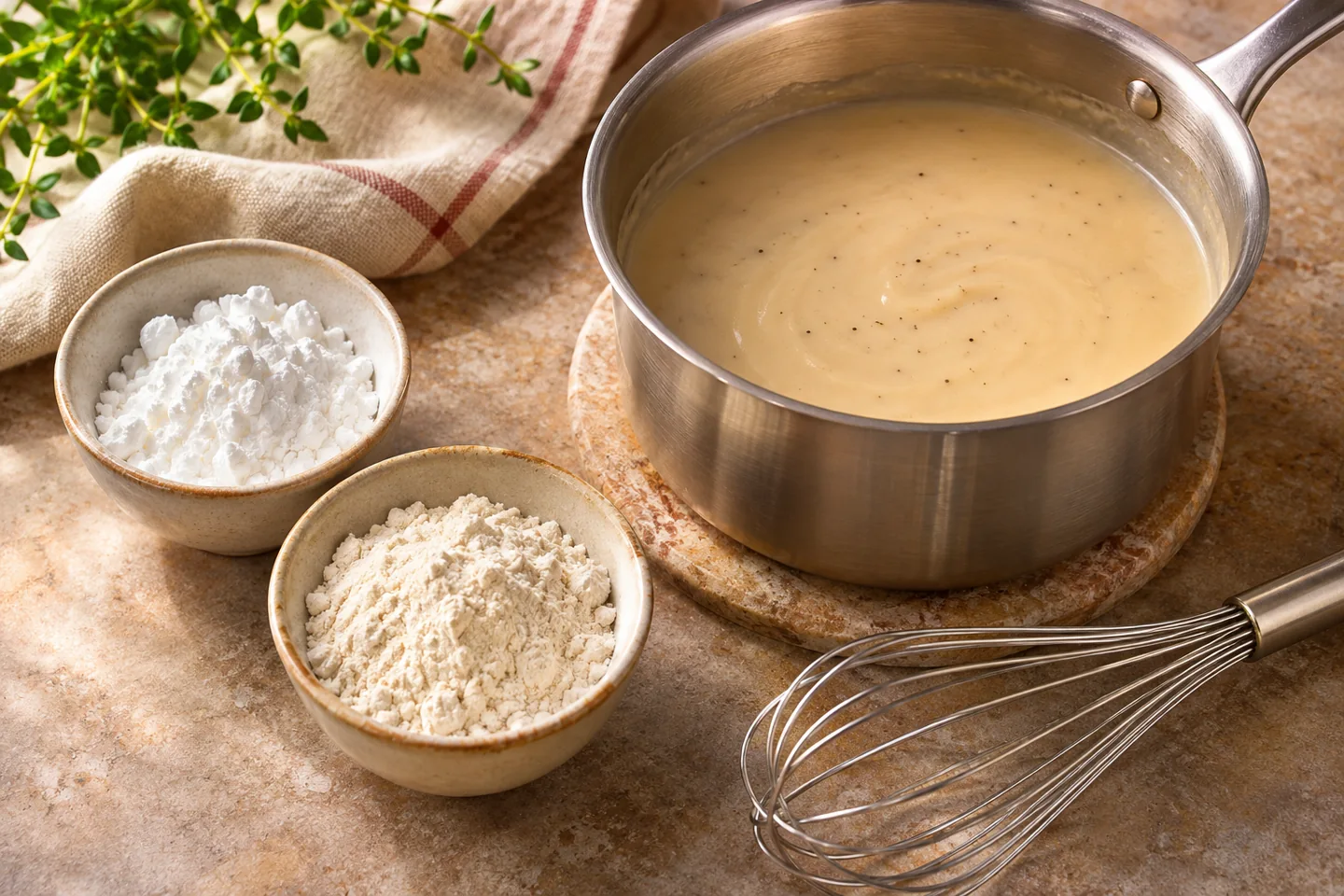
Cornstarch usually thickens more efficiently and gives a more translucent finish than ordinary wheat flour. Flour produces a more opaque sauce and is commonly used in a cooked fat-and-flour roux. Choose according to the texture, appearance and cooking method you want. A direct spoon-for-spoon swap can change the result because the two ingredients contain different proportions of starch.
Both work because starch changes when heated with water. The main practical challenges are dispersing it without lumps, heating it enough to thicken, and avoiding later treatment that weakens the finished sauce. Understanding those stages is more useful than memorising a single substitution ratio for every gravy and filling.
Cornstarch and flour compared
| Feature | Cornstarch | Wheat flour |
|---|---|---|
| Composition | Mostly isolated starch | Starch plus protein and other grain components |
| Typical appearance | More translucent, often glossy | More opaque and creamy-looking |
| Common preparation | Slurry with cool liquid | Roux with fat, or another recipe-specific dispersion |
| Amount needed | Usually less for comparable thickening | Usually more, depending on method |
| Dietary check | Check gluten-free labelling when required | Ordinary wheat flour contains gluten |
What happens when starch thickens a liquid?
Starch exists in granules. When those granules are heated in enough water, they take up moisture and swell. Some starch molecules move into the surrounding liquid, and the mixture becomes more resistant to flowing. This process is often called gelatinisation.
It requires suitable conditions. A dry powder added to a pan does not instantly create an even thickener just because the pan is hot. The granules need contact with water, and they need to be distributed throughout the liquid before local thickening traps dry powder inside lumps.
Different starches and recipes behave differently because granule structure, available water and other ingredients vary. Sugar, acid, fat and cooking history can all affect the result. A sauce that thickens perfectly in one recipe may need a different method when the liquid becomes much sweeter or more acidic.
Why cornstarch generally needs a smaller quantity
Cornstarch is a concentrated starch ingredient. Wheat flour also supplies starch, but part of its weight comes from protein and other components. Equal spoonfuls therefore do not contain equal quantities of the material mainly responsible for thickening.
This is the reason many substitution guides use less cornstarch than flour. However, the desired consistency and cooking process still matter. A lightly thickened broth, a glossy stir-fry sauce and a firm pie filling are different targets, so one ratio should not be treated as a guarantee across all three.
Measure the thickener carefully and start from a recipe appropriate to the dish. If making an adjustment, allow the mixture to reach its intended cooked state before deciding it needs more. Adding successive spoonfuls while the first addition has not finished working can lead to an unexpectedly stiff sauce.
How a cornstarch slurry prevents lumps
A slurry disperses cornstarch in a small amount of cool liquid before it enters the hot pan. The cool liquid separates the particles without immediately swelling them into a thick outer layer. When the slurry is stirred into the sauce, the starch can spread through the larger volume before thickening.
Stir the slurry again immediately before adding it, because starch can settle while it stands. Add it with controlled stirring according to the recipe, then heat until the sauce reaches the stated texture. Simply pouring in a slurry and turning off the heat may leave it insufficiently cooked.
A slurry is not a licence for unlimited boiling afterward. Prolonged heating, especially in combination with acid and agitation, can weaken a starch-thickened mixture. Once the intended consistency is reached, use the recipe’s holding instructions rather than keeping the sauce at a vigorous boil while you prepare everything else.
How a flour roux works
A roux disperses flour in fat and cooks it before liquid is incorporated. The fat helps separate the flour particles, reducing the tendency for dry centres to become trapped inside wet lumps. As liquid is added and the mixture heats, the starch becomes able to hydrate and thicken the sauce.
Cooking also changes flavour. A pale roux and a deeply browned roux are not interchangeable simply because both started as flour and fat. Longer browning develops a different flavour and colour while reducing thickening power, so a recipe designed for one stage may not behave correctly at another.
Add liquid and stir according to the method, paying attention to the corners of the pan where thick material can collect. A whisk can be useful, but the goal is even incorporation, not frantic movement. Allow the finished sauce to cook sufficiently for its intended texture and flavour rather than judging it immediately after the liquid goes in.
Why dumping dry powder into hot sauce causes trouble
The outside of a clump contacts hot water first and can swell rapidly. That creates a sticky coating around dry material inside. Stirring then moves the lump around without necessarily letting the inner powder disperse. Both flour and cornstarch can cause this problem.
If a sauce is lumpy, straining may remove the lumps but also removes some of the thickener. Blending can improve some sauces, though it is inappropriate for preparations where you want intact pieces or where aggressive mixing worsens texture. Choose the remedy according to the dish, not a universal instruction to blend everything.
Preventing lumps is simpler: use the recipe’s slurry, roux or other dispersion method. If a nearly finished sauce needs adjustment, make a controlled small addition using a suitable method rather than sprinkling an unknown amount of powder over the surface.
Acid, sugar and long cooking change the outcome
Acidic ingredients can reduce starch thickening during extended heating. A sauce may initially thicken and then become thinner as cooking continues. In a sweet preparation, sugar also competes for water and can alter when starch thickens. These effects explain why fruit fillings often need a recipe tailored to the fruit and sugar level.
Adding more starch without addressing the method may give a pasty result or repeat the same problem. Consider when the acidic ingredient is introduced and how long the sauce is held hot, following a tested recipe where the balance is important.
For a dish that will be cooked, cooled, frozen and reheated, choose a formulation designed for that sequence. Some starch-thickened sauces release water or change texture after chilling and freezing. The best thickener for immediate serving is not automatically the best for a frozen meal.
Judge consistency at the serving temperature
Many starch-thickened mixtures become thicker as they cool. A gravy that looks slightly loose while very hot may reach the desired consistency on the plate. Conversely, a sauce reduced until it seems perfect in the pan may become heavy and pasty by the time dinner is served.
Check a small cooled sample when that is appropriate to the dish. If the sauce is too thick, add suitable liquid gradually and incorporate it evenly. Remember that dilution also changes seasoning, so make final flavour adjustments after texture is under control.
If it is too thin, first confirm that the starch has received enough heat and that the sauce has not been inadvertently diluted. Then make a measured adjustment. Keeping track of the added liquid and thickener will make the next batch easier to reproduce.
Names and dietary details to check
In some countries, “cornflour” means the fine white starch sold as cornstarch in the United States. Elsewhere, corn flour can mean finely ground whole corn. These are different ingredients. Check the package description and appearance rather than translating the name alone.
Ordinary wheat flour contains gluten. Pure cornstarch is a different ingredient, but people who must avoid gluten should check the product’s labelling and cross-contact information. A sauce also contains other ingredients, such as stock or seasoning blends, that may matter for dietary suitability.
Common questions
Which is better for gravy?
Flour often suits a traditional opaque gravy and a roux method; cornstarch can suit a smoother, more translucent finish or a gluten-free formulation when all ingredients qualify. Choose based on the result and recipe.
Can I use the same amount when substituting?
Do not assume so. The starch concentration and cooking method differ. Use a recipe-specific conversion and assess the finished sauce at its serving temperature.
Sources and further reading
This explanation draws on Harold McGee, On Food and Cooking, second edition (2004), starch-thickened sauces, flour and starch sections. For practical ingredient planning, see our pantry staples and meal ideas.
Prepared with AI assistance from the cited source. This is an ingredient explainer, not a separately kitchen-tested recipe. Featured image: AI-generated illustration.