 KINSMC
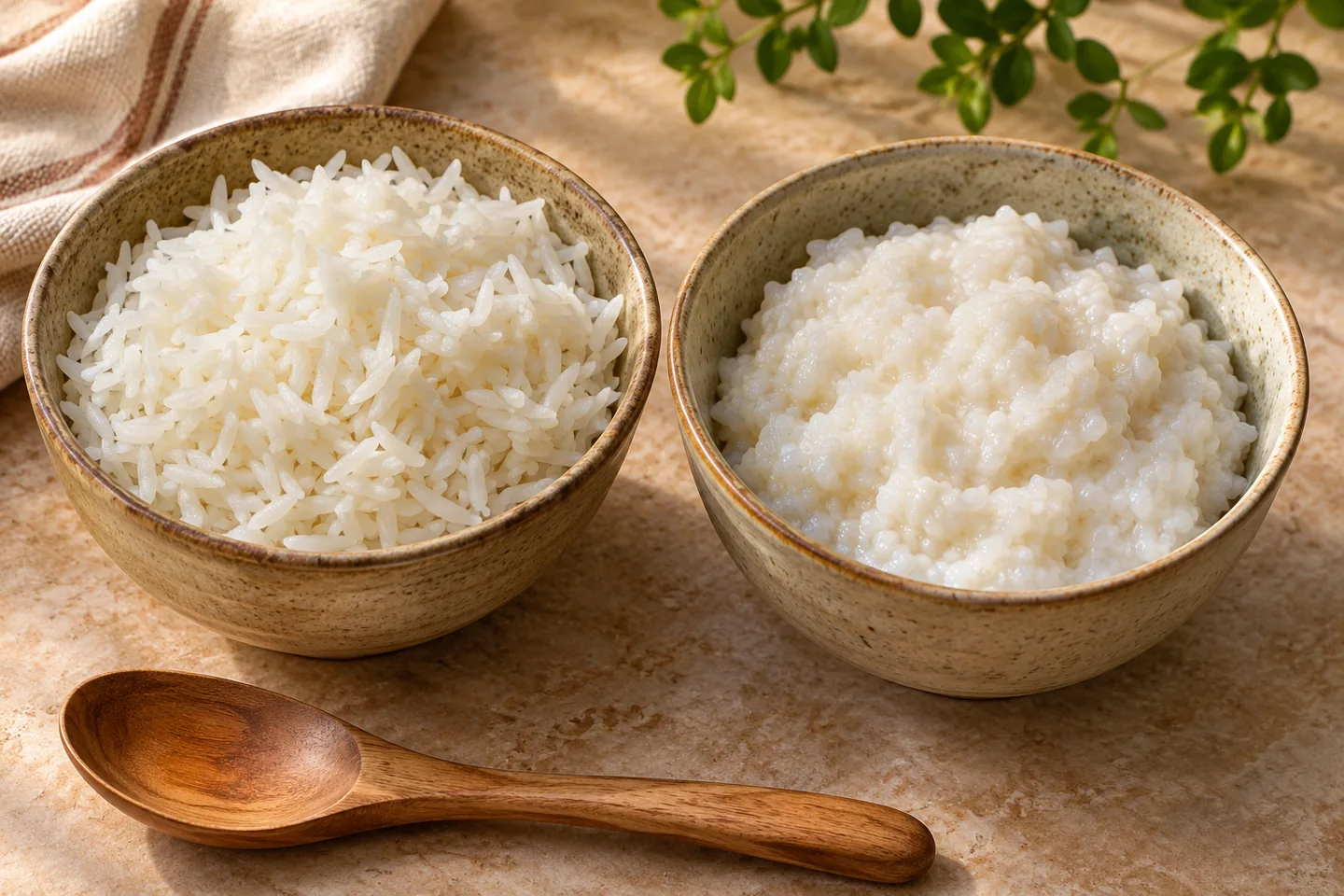
Rice becomes mushy when its grains absorb too much water, cook too far or release enough starch to make the surrounding liquid sticky. The cause may be excess water, prolonged cooking, vigorous stirring or a method unsuited to the variety. Once the grains have broken down, you cannot fully turn them back into separate, fluffy grains.
A little surface moisture is different from a pot of collapsed rice. Identify which problem you have before trying to fix it. Sometimes a brief rest is all that is needed; sometimes the better decision is to use the rice in a dish that welcomes a soft texture and adjust the next batch.
First decide what “good rice” means for your dish
Separate grains are desirable for some meals, but they are not the goal of every rice preparation. Risotto, congee, rice pudding and many short-grain dishes intentionally use moisture and released starch to create a different texture. A method that makes excellent porridge would be a poor choice for a fluffy side dish.
Rice varieties differ in their starch composition and structure. Long-grain, short-grain, brown and parboiled products do not all absorb water or soften at the same rate. Even within a broad category, the package instructions may differ. Start with the variety and dish together instead of a single universal water ratio.
The equipment matters as well. A covered saucepan, an open pot of excess water, a pressure cooker and a rice cooker lose different amounts of moisture. A ratio that works in one setup may fail when transferred unchanged to another.
What happens as rice cooks?
Heat and water change the starch inside a rice grain. The grain absorbs moisture, starch granules swell and the texture softens. Some starch can move into the surrounding water, especially from damaged surfaces or when grains are disturbed during cooking.
If the grain takes on more water than the desired texture requires, or remains hot and wet for too long, its structure becomes increasingly soft. Stirring can rub softened grains together and release more starch. The result may be a sticky coating, broken grains or a pot that resembles porridge.
This explains why simply draining an overcooked pot does not undo the problem. Draining removes free water outside the grains. It does not remove all the water already absorbed or rebuild the grain structure that has softened and broken.
Diagnose the pot in front of you
| What you find | Likely issue | What may help |
|---|---|---|
| Tender grains with some free water | More liquid than the method needed | Drain if appropriate, then let steam escape briefly |
| Soft, split grains and paste | Overhydration or overcooking | Repurpose; the original grain texture cannot be restored |
| Sticky surface but intact grains | Surface starch, stirring or the variety itself | Check rinsing and handling for the next batch |
| Hard centre with a wet exterior | Uneven or incomplete cooking | Follow the method’s controlled cooking adjustment, not a large extra pour |
| Scorched bottom with uneven upper layers | Heat distribution, pot or cooking control | Avoid scraping burnt material through the entire batch |
Why too much water is not always a measuring mistake
With an absorption method, the added water has several destinations: some enters the grains, some remains around them and some escapes as steam. The amount lost depends on the lid, heat, pot dimensions and cooking time. A very tight lid and gentle heat may retain more water than the setup used to develop a recipe.
Rinsed rice can also carry water into the pot. Soaked rice already contains absorbed water before cooking begins. If a recipe assumes dry, unsoaked rice, adding the full specified quantity to a heavily soaked batch changes the starting conditions.
Use a consistent measuring method and drain rinsed rice consistently. If you soak, follow a method written for soaked rice. Do not combine soaking instructions from one recipe, a water ratio from another and a cooking time from a third, then judge the rice variety as the problem.
When rinsing helps—and when it changes the recipe
Rinsing removes some loose surface starch that could otherwise thicken the cooking water and coat the grains. This can help when the goal is a cleaner, more separate texture. It does not make every rice variety behave like a long-grain variety, and it cannot prevent mushiness caused by substantial overcooking.
Follow package directions, especially where a product has been enriched or prepared for a specific method. Some dishes depend on starch entering the liquid, so aggressive rinsing may work against the intended result. The instruction “always rinse rice” is less useful than understanding the dish and the product.
Rinsing is also not a food-safety treatment for cooked rice. It does not remove the need for proper cooking, prompt cooling and appropriate storage. Keep quality techniques separate from safety claims.
Stir less when separate grains are the goal
Once grains soften, repeated stirring increases contact and abrasion. It can release starch and break delicate grains. For a covered absorption method intended to produce separate rice, follow the recipe’s initial stirring instruction and then leave the pot alone for the stated cooking period.
Lifting the lid repeatedly also changes steam retention and temperature. That can make it harder to reproduce a method. If you need to inspect for doneness, do so deliberately rather than stirring every few minutes because nothing appears to be happening.
After cooking, a rest can allow moisture to redistribute and the grain texture to settle. Fluff gently with an appropriate utensil instead of vigorously beating the pot. Resting helps a correctly cooked batch finish well; it cannot reverse grains that have already disintegrated.
What you can do with a wet batch
If the grains are just tender and there is free liquid, removing that excess may improve the result. Use a strainer when that suits the rice and method, then allow a short period for steam to escape. Avoid extending cooking indefinitely in the hope that every drop will evaporate before the grains soften further.
If the rice is already very soft, choose a dish where that quality fits. A savoury rice soup or porridge can be more successful than trying to force it into a salad that needs separate grains. A sweet pudding may be possible if the rice has not already been strongly seasoned.
Fried rice is not a universal rescue for mushy rice. Cooling can firm rice somewhat, but it does not reconstruct broken grains, and excess starch may still cause clumping. Never leave rice out for hours merely to dry it for frying.
Cool leftover rice promptly
The UK Food Standards Agency advises cooling cooked rice as quickly as possible, ideally within one hour, refrigerating it and using it within 24 hours. Reheat only once and make sure it is steaming hot throughout. Rice can contain bacterial spores that survive cooking, and unsafe storage can allow growth and toxin production; reheating is not a dependable remedy for rice left warm too long.
Divide leftovers into smaller portions so they cool efficiently rather than leaving a large warm pot on the counter. Follow local food-safety guidance and your appliance instructions. A change in smell or appearance is not a reliable warning system for every rice-related hazard.
Make the next batch easier to diagnose
- Keep the rice variety constant. Start with the package method or a recipe written for that product.
- Measure consistently. Record rice, water, rinsing and soaking rather than guessing after the fact.
- Use the same pot and lid. Equipment changes can alter evaporation.
- Control the heat. A vigorous boil and a gentle covered simmer do not behave identically.
- Change one thing next time. If everything was soft, adjust the identified excess rather than changing variety, water and timing together.
Common questions
Can I bake mushy rice to make it fluffy?
Drying may remove surface moisture, but it cannot reliably restore collapsed grain structure. It may also dry exposed areas unevenly. Repurposing is often a better use of a badly overcooked batch.
Why is brown rice still hard when white rice would be cooked?
Its outer layers and structure change the cooking requirements. Use instructions for brown rice instead of applying a white-rice timing unchanged.
Sources and further reading
Rice and starch science: Harold McGee, On Food and Cooking, second edition (2004), rice and cereal-cooking sections. Current safety guidance: Food Standards Agency home food fact checker. For planning meals around grains and legumes, see our plant-based pantry guide.
Prepared with AI assistance from the cited sources. This is a troubleshooting guide, not a separately kitchen-tested recipe. Featured image: AI-generated illustration.