 KINSMC
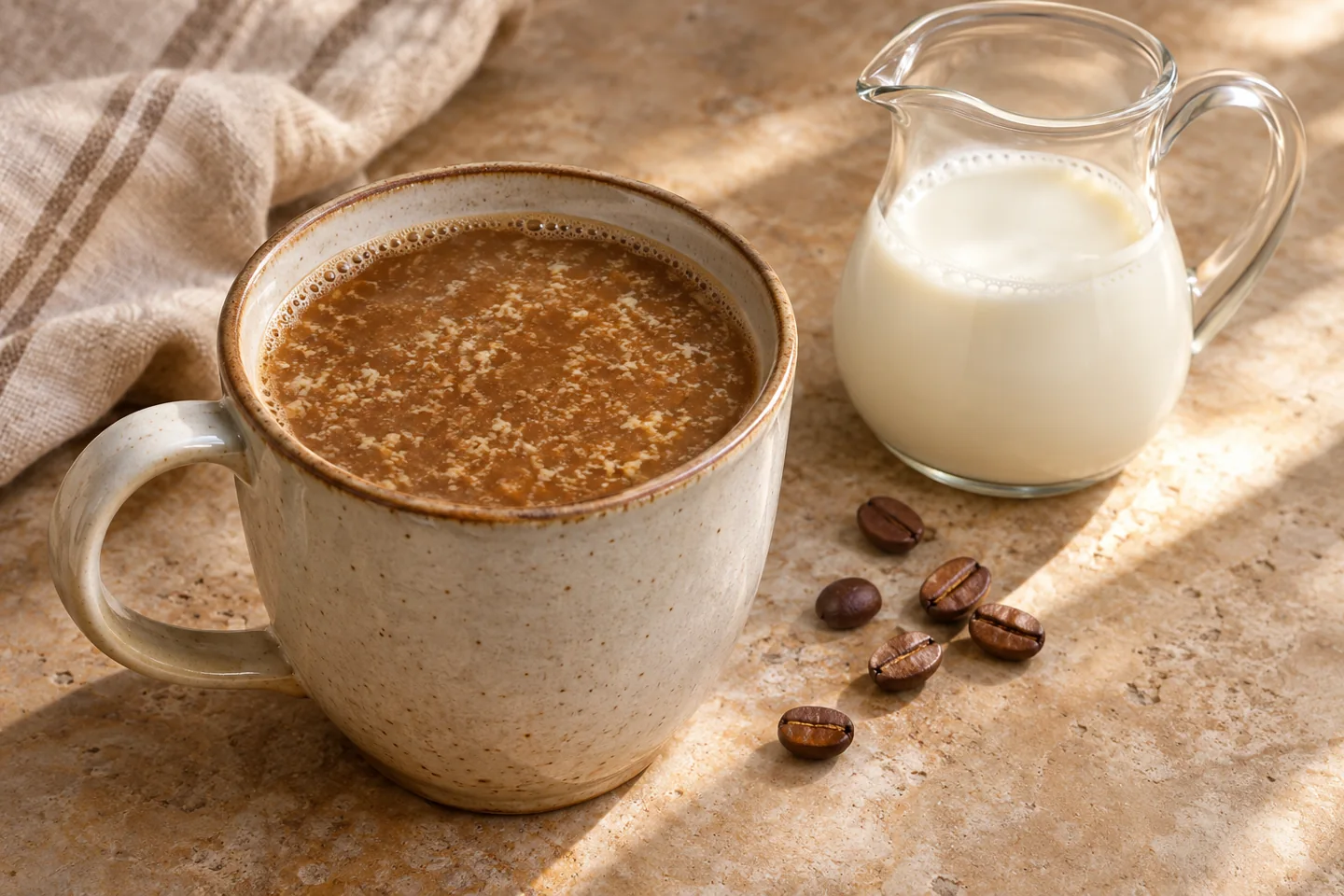
Milk can curdle in coffee when acidity and heat cause its proteins to gather into visible clusters. Older or improperly stored milk may be more prone to curdling, but fresh milk can also react badly to a particular cup of hot, acidic coffee. Flecks in the cup are therefore a texture clue, not a reliable safety test.
The first decision is whether the milk is suitable to use at all. Only after checking storage, dates and the product’s condition should you experiment with coffee temperature or pouring technique. If the milk is spoiled or its storage is uncertain, changing the brewing method does not solve the underlying problem.
What is happening inside the cup?
Milk contains proteins dispersed in water, along with fat, lactose and minerals. Much of its protein is organised in tiny structures that normally remain suspended. Acidity changes the interactions that keep these structures apart. Under the right conditions, they join into clusters large enough to see.
Heat can make an unstable combination more likely to show visible aggregation. Coffee adds both acidity and warmth, so the same milk may look normal in the carton but form flecks when it enters the cup. The effect depends on the milk, coffee, temperature and proportions together; it is not determined by one ingredient name alone.
Milk that has become more acidic during storage can be closer to the point where proteins aggregate. That is one reason a carton approaching the end of its usable life may behave differently from a newly opened one. However, you cannot establish microbial safety by seeing whether a spoonful survives a coffee test.
Curdling, separation and a milk skin are not identical
| Appearance | Possible explanation | Useful check |
|---|---|---|
| Small pale flakes throughout coffee | Protein aggregation in the hot, acidic mixture | Check milk condition, coffee temperature and product compatibility |
| A film across heated milk | Surface changes involving evaporation and milk components | Review heating method; a skin is not the same as dispersed curds |
| Creamy layer in non-homogenised milk | Fat rising during storage | Read the product’s handling instructions |
| Clumps already present in the carton | A product problem that may include spoilage | Do not use coffee to disguise it; follow storage and disposal guidance |
Plant drinks can also settle or separate for reasons that differ from dairy milk. Some contain suspended particles and added stabilisers, and their behaviour changes with formulation. Shake only when the package directs you to do so, and do not assume every separation is harmless merely because the drink is plant-based.
Start with the milk, not the coffee
Check the storage instructions and relevant date on the carton. Consider when it was opened and whether it stayed refrigerated when required. A carton left warm during a shopping trip or on a breakfast table has a different history from one returned promptly to a cold refrigerator.
Look for obvious changes such as unusual lumps, leakage or an abnormal odour. These can justify discarding the product, but their absence does not prove safety. Do not taste suspicious milk to decide whether it is safe. If the storage history makes it unsuitable, stop troubleshooting and replace it.
The FDA recommends keeping refrigerated perishables at 40°F/4°C or below and refrigerating them promptly. Shelf-stable milk has its own unopened storage instructions; after opening, follow the carton’s refrigeration directions. The fact that a product was sold outside a chiller does not mean an opened carton can stay on the counter indefinitely.
Then consider the coffee temperature
If you have established that the milk is suitable to use, try letting the freshly brewed coffee cool slightly before combining it. You are reducing one source of stress on the milk proteins. You do not need to abandon hot coffee, but pouring milk into coffee at its hottest possible moment may be less forgiving.
Use a small cup for comparison so you can change one variable at a time. Keep the same coffee, the same milk and a similar proportion. Compare immediate mixing with mixing after a brief cooling period. If the cooler cup remains smoother, temperature is a useful part of your diagnosis.
A change in appearance is not evidence that the warmer cup was unsafe or the cooler cup safe. This comparison is about texture using ingredients already judged suitable for consumption. It should not be used to rehabilitate milk with an uncertain storage history.
Why the coffee itself can make a difference
Coffees differ in acid composition and concentration, and brewing changes what ends up in the cup. A milk that works in one coffee may separate in another. Stronger flavour, darker colour and perceived bitterness do not directly tell you the mixture’s acidity.
If one coffee repeatedly produces the problem with fresh milk, try another coffee while keeping the milk and serving temperature similar. Avoid making simultaneous changes to roast, water, brewing method, milk and cup temperature, because that leaves you unable to identify which change helped.
Do not rely on a universal claim that every dark roast or every cold brew will solve curdling. Products and preparation vary. Your practical goal is a compatible combination you enjoy, not a rule that every bean and milk must obey.
Does the order of pouring help?
Combining ingredients gradually and stirring can avoid exposing a small amount of milk to the full heat and acidity of a large volume of coffee all at once. Some people obtain a smoother result by adding coffee gradually to milk, or by gently warming suitable milk before mixing.
These are ways to change the immediate mixing conditions, not guarantees. If the final mixture is sufficiently unfavourable to the proteins, changing the order alone may not prevent separation. If you warm milk, do so carefully and use it promptly rather than repeatedly heating and cooling the same carton.
Avoid adding bicarbonate simply to make a questionable cup look smooth. It changes flavour and acidity and does not make spoiled milk safe. For ordinary coffee preparation, choosing fresh, compatible ingredients and moderating heat is a clearer approach than adding an unmeasured chemical adjustment.
Why soy and oat drinks behave differently
Soy drinks contain plant proteins that can also respond to acid and heat. Oat drinks have a different balance of protein, starch-derived components, oil and stabilisers. There is considerable variation within each category, so the word “oat” or “soy” alone does not predict the result.
Products labelled for barista use are formulated with coffee performance in mind. That may make them a more convenient choice, but check the individual product’s instructions and ingredient list. A barista label does not make every product nutritionally identical or equally suitable for every person’s dietary needs.
If you are comparing products, consider protein, sugars, fortification and allergens as well as performance in coffee. Our soy milk versus oat milk guide explains those label differences. Choose the carton for its full role in your diet, not only for the smoothest-looking latte.
A simple troubleshooting sequence
- Reject unsuitable milk. Check its date, opening history and storage before any experiment.
- Use a small fresh portion. Keep the rest refrigerated while you work.
- Reduce the coffee’s initial heat. Compare with the same ingredients rather than changing everything.
- Mix gradually. Stir gently and observe whether the texture improves.
- Try another compatible product. If necessary, compare a different coffee or a milk formulated for coffee, one change at a time.
- Record the successful combination. The product name and method are more useful than a vague conclusion that all milk behaves the same.
Common questions
Does curdled milk in coffee always mean the milk was bad?
No. Heat and acid can make otherwise suitable milk aggregate. However, curdling does not prove that the milk was safe either. Its condition and storage history still matter.
Can I strain out the flakes?
Straining may alter the texture, but it does not resolve spoilage or unsafe storage. It also does not restore the original distribution of proteins in the drink.
Why does the same carton work one day and fail another?
The carton may have changed during storage, or the coffee temperature, concentration and mixing conditions may differ. Review both ingredients and handling rather than assuming a single cause.
Sources
Protein and milk behaviour: Harold McGee, On Food and Cooking, second edition (2004), milk chemistry and cooking sections. Refrigeration reference: FDA guidance on chilling perishable foods.
Prepared with AI assistance from the cited sources. Featured image: AI-generated illustration. Appearance alone cannot establish food safety.