 KINSMC
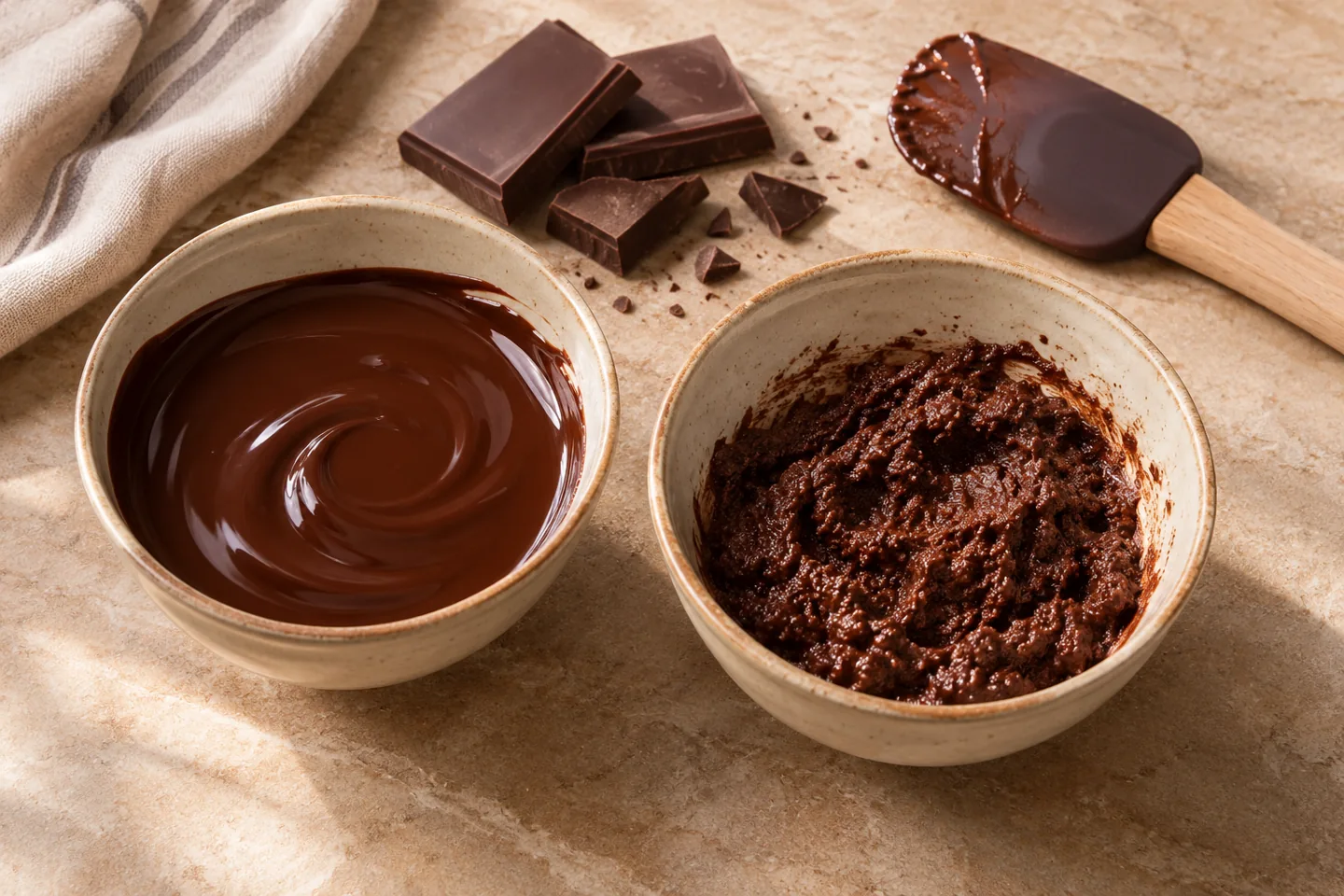
Melted chocolate can seize when a small amount of water makes its sugar and cocoa particles stick together into a thick paste. The surprising part is that enough additional liquid can sometimes turn that paste into a smooth sauce. It will not restore the chocolate to its original use as a dry, tempered coating, and it cannot remove a burnt flavour.
Before trying a rescue, decide what happened and what you need the chocolate to do. A sauce, a ganache, a dipped strawberry and a moulded chocolate shell require different structures. A fix that works beautifully for a spoonable dessert sauce may prevent a coating from setting properly.
Seized chocolate is not the same as every grainy chocolate
| Problem | Typical clue | What the clue means |
|---|---|---|
| Seizing | Chocolate suddenly thickens after contact with a little liquid or steam | Particles may have clumped together around limited moisture |
| Scorching or overheating | Excessive heat, harsh smell or burnt flavour | Cooling or adding liquid cannot undo burnt flavour |
| Bloom on solid chocolate | Pale or streaky surface after storage | A surface change that needs separate assessment from seizing during melting |
These clues are useful, but they are not a laboratory diagnosis. More than one problem can occur in the same bowl. Chocolate left over high heat may receive condensation and overheat at the same time. If you know both occurred, do not assume solving the water problem will solve the heat damage.
What melted chocolate actually contains
Chocolate is not simply a sugary liquid when it melts. Tiny solid particles, including sugar and cocoa solids, are distributed through a fat phase largely supplied by cocoa butter. Melting the fat lets those particles move past one another, producing the familiar flowing texture.
A small amount of water changes how the particles interact. Instead of dissolving all the sugar into a generous liquid phase, it wets limited areas and helps neighbouring particles join. The mixture becomes thick and rough because those clusters no longer move as freely through the fat.
This is why the phrase “water ruins chocolate” is incomplete. The amount and the intended preparation matter. Chocolate sauce, hot chocolate and many ganaches contain water, either directly or within milk or cream. They work because they are formulated as mixtures with enough liquid, not because their ingredients somehow contain no water.
Common routes for accidental moisture
A bowl placed over simmering water can collect condensation underneath. Lifting it and allowing drips to run over the rim can introduce moisture. Steam can also reach the chocolate if the bowl is poorly positioned or the water is boiling vigorously.
A recently washed spatula, a damp bowl or wet fruit can contribute enough water to create trouble during coating. Liquid flavourings are another source: a small splash added to otherwise plain melted chocolate may have a very different effect from the same flavouring added to a properly formulated sauce.
Check these points before you start. Dry the bowl and utensils thoroughly, keep steam away from the chocolate, and make sure anything being dipped is appropriately dry. Preparation is usually easier than deciding how to repurpose a seized batch halfway through decorating.
How to assess whether a sauce rescue is suitable
- Remove the chocolate from the heat. Continuing to heat an already thick mixture can add a second problem.
- Consider its history. A sudden change after a drip of water suggests a different problem from prolonged exposure to high heat.
- Choose the final use. If a sauce or liquid-containing filling is acceptable, adding liquid may be useful. If you need a crisp shell, start a fresh suitable batch.
- Use a deliberate recipe where possible. The amount and type of chocolate, the liquid and the desired final consistency all affect the result.
- Assess flavour and texture before committing more ingredients. A rescue that stays unpleasant is not improved by turning it into a large dessert.
Why adding more liquid can work
With sufficient liquid, the sugar can dissolve more fully and the particles can disperse in a different kind of mixture. The original clumped paste can become a smooth chocolate preparation. This is a change in the system, not a reversal that recreates plain melted chocolate.
Warm liquid is often easier to combine with melted chocolate than a large cold addition that immediately chills the fat. Add and stir deliberately, following a sauce or ganache method suited to your ingredients. Do not keep adding isolated drops while expecting every intermediate stage to become thinner; a very small amount may leave the mixture in the clumped stage.
There is no universal rescue quantity for every chocolate. A high-cocoa dark chocolate, a sweet milk chocolate and white chocolate differ in sugar, fat and other solids. The final use matters too: a pourable sauce needs a different balance from a filling intended to set softly.
Once you add cream or milk, storage requirements change. Do not assume the shelf life of the original chocolate bar applies to the finished sauce. Follow a suitable recipe’s storage instructions and keep dairy-containing preparations appropriately refrigerated.
Why oil is not an equivalent repair
Adding fat can alter how chocolate flows, but it does not dissolve sugar in the way water does. It also changes the final composition and setting behaviour. A spoonful of oil is therefore not a universal answer to a paste created by accidental moisture.
Some coating recipes intentionally include added fat to produce a softer or thinner finish. That is a designed preparation with a particular result. It should not be confused with restoring a chocolate that was supposed to set into a firm, glossy tempered shell.
Butter also contains water unless it is a specially clarified product, so adding it casually introduces more than fat. If a recipe calls for butter, follow that recipe’s method and proportions. Ingredient names that sound interchangeable can have quite different effects in a moisture-sensitive mixture.
Melting and tempering are different jobs
Melting makes solid chocolate fluid. Tempering manages cocoa-butter crystals so the chocolate sets with the desired appearance and texture. A bowl can contain smoothly melted chocolate that is not in temper. Equally, a successful sauce rescue does not mean the mixture is now suitable for tempering like a plain chocolate bar.
For dipping, moulding or decorations that need snap and gloss, use a tempering method appropriate to the exact chocolate. Manufacturer instructions are more useful than a single temperature copied across dark, milk and white chocolate. Their compositions are different, and compound coatings may follow another process entirely.
For brownies or some cake batters, the recipe may only require melting rather than tempering. Even then, an improvised rescue changes the amount of liquid or fat entering the batter. Do not add a converted chocolate sauce to a recipe as if its weight were still entirely plain chocolate.
A calmer melting routine
Chop solid chocolate into reasonably even pieces so small pieces do not spend too long hot while a large chunk remains solid. Use gentle heat and stir to distribute it. In a microwave, use short intervals according to the appliance and recipe, stirring between them because the appearance alone may hide uneven heating.
Over a water bath, keep the water gentle and avoid contact between the bowl and aggressively boiling water. Dry the underside before moving the bowl near the work surface. Remove the bowl when residual warmth and stirring can finish melting the remaining pieces, rather than holding everything over heat indefinitely.
Have flavourings and other recipe ingredients measured before starting. If your recipe intentionally mixes chocolate with liquid, follow its sequence. A method written for a cream-based ganache is not the same as melting plain chocolate for a shell.
Common questions
Can seized chocolate still be used?
Often it can be repurposed into a liquid-containing preparation if it has not burnt or been contaminated. The intended texture and the added ingredients determine whether the rescue is useful.
Will simply cooling it fix the problem?
Cooling can address excess warmth, but it does not reliably separate particles that have clumped because of limited moisture. Diagnose the cause rather than repeating heating and cooling cycles.
Is a white surface proof that chocolate has seized?
No. Bloom is a surface change on solid chocolate and has different causes. Seizing usually describes the sudden thickening encountered while working with melted chocolate.
Sources and further reading
Harold McGee, On Food and Cooking, second edition (2004), chocolate preparation and handling sections. See also King Arthur Baking’s explanation of chocolate and water. For understanding sugar information on packaging, read our added sugar versus total sugar guide.
Prepared with AI assistance from the cited sources. This is a technique explainer, not a separately kitchen-tested recipe. Featured image: AI-generated illustration.