 KINSMC
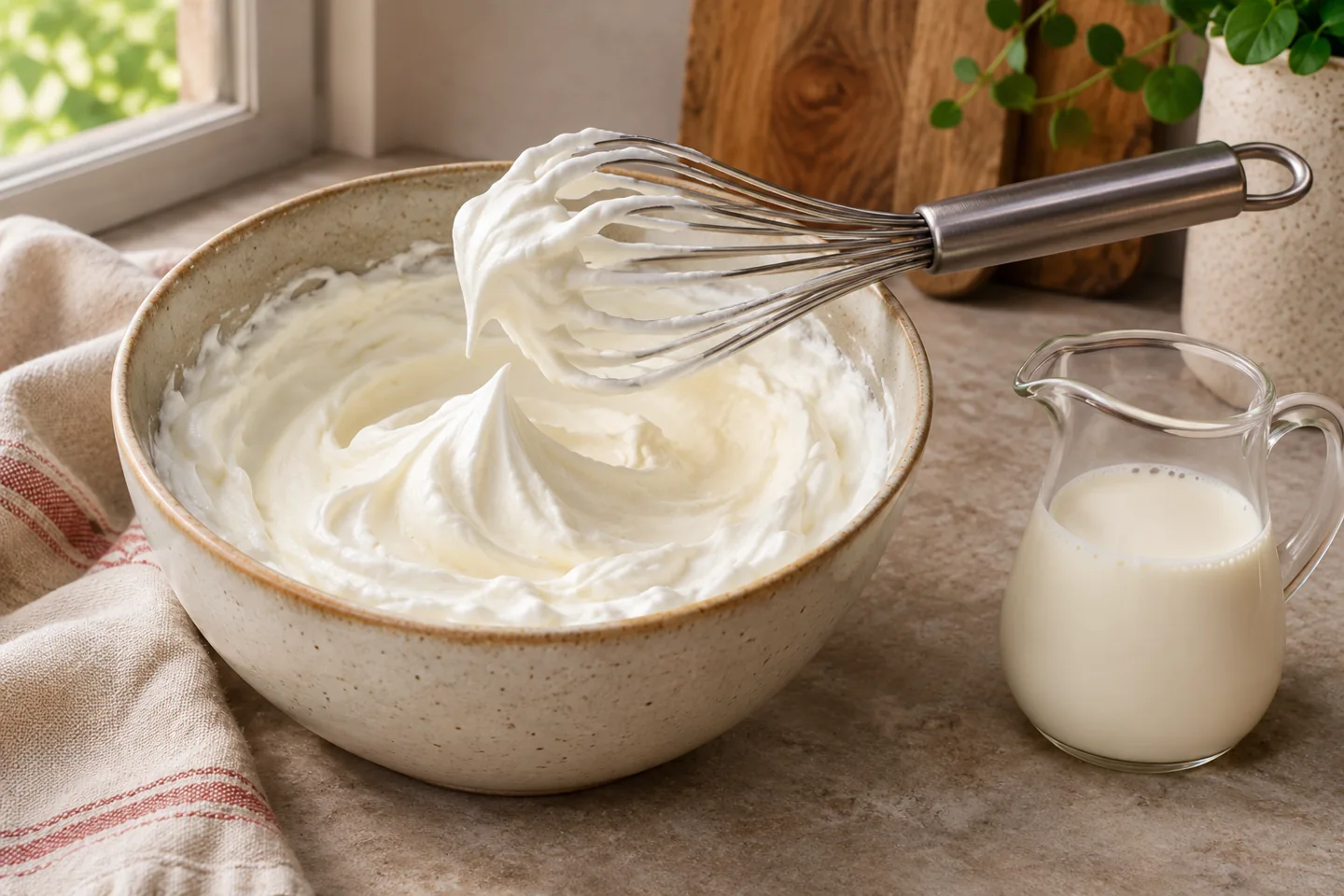
Cream usually fails to whip because it is too warm, does not contain enough fat for whipping, or has already been beaten beyond the useful stage. Start with a product labelled suitable for whipping, keep it cold and watch the texture instead of relying only on a timer. Cream that stays liquid needs a different response from cream that has become grainy.
Whipped cream is a foam supported by a network of partially joined fat droplets. That structure explains both its lightness and its fragility. Temperature, fat content and the amount of beating determine whether the network forms, stays smooth or progresses toward butter. Identifying the stage you are at is the quickest way to choose a sensible fix.
Diagnose the texture first
| What you see | What to check | Next step |
|---|---|---|
| Liquid with a little froth | Product type, fat content and temperature | Check the label and chill suitable cream before trying again |
| Soft peaks that bend | The texture requested by your recipe | This may be the correct finishing point |
| Dull, slightly grainy cream | Early overwhipping | Stop; a little cold liquid cream may smooth it |
| Yellowish clumps with separate liquid | Advanced fat separation | Do not expect it to return to ordinary whipped cream |
| Cream was fluffy but now slumps | Warm serving conditions or long holding | Keep chilled and use a suitable stabilised recipe when needed |
Why fat content matters
Milk and cream contain fat droplets dispersed in water. During whipping, air is introduced and some fat droplets begin sticking together around the air bubbles. Enough of that supporting network has to form to hold a foam. A liquid can contain dairy fat and still have too little to behave like whipping cream.
Ordinary dairy whipping creams typically contain around 30% fat or more, although names and legal categories vary between countries. The most useful buying instruction is therefore the manufacturer’s stated use, not a familiar-looking carton. Products labelled single cream, light cream, cooking cream or half-and-half may behave very differently.
Adding more beating time cannot create missing fat. If the product is unsuitable, stop before the mixer warms it further. Use it for a purpose that fits its formulation and buy whipping cream for the topping. Combining a low-fat liquid with other ingredients without a tested recipe is not a reliable way to reproduce a commercial whipping product.
Why cold cream whips more reliably
Part of the fat in cold cream is firm enough to help form a stable network. As it warms, too much of that fat becomes liquid and the support for the bubbles weakens. Warm cream may froth without building the body you expect, or a finished foam may soften rapidly.
Refrigerate the cream until you are ready to use it. In a warm kitchen, a chilled bowl and whisk can help limit warming during the process. A metal bowl responds quickly to chilling, but the goal is simply to keep the mixture cold, not to freeze it into hard pieces.
If otherwise suitable cream remains loose and the bowl has become warm, pause and return it to the refrigerator before trying again. Do not leave it on the counter while troubleshooting other ingredients. Whipping introduces mechanical energy, so prolonged high-speed mixing can make an already warm batch less cooperative.
Use the right bowl and batch size
The whisk has to reach the cream and move it effectively. A very small quantity in a large stand-mixer bowl may sit below much of the whisk’s working area. It can look as if the ingredient is failing when the equipment is barely incorporating air. A smaller bowl and hand whisk or handheld mixer may suit that quantity better.
Conversely, a bowl filled too high leaves little space for the foam to expand and increases splashing. Choose a vessel with enough room for the cream to grow in volume. Keep the bowl clean and free of residual washing water that would dilute the mixture.
Start at a manageable speed and increase as the cream thickens, following the equipment and recipe instructions. Near the finishing point, reduce the speed or finish by hand. A powerful mixer can move from smooth peaks to graininess quickly, particularly with a small batch.
Soft peaks and stiff peaks are different destinations
At soft peaks, cream holds a mound but the tip bends over when you lift the whisk. That texture often works well for spooning onto fruit or folding into another mixture. It should not be dismissed as a failure simply because it is not rigid.
Stiffer peaks hold their shape more firmly and can suit some piping or topping tasks. There is still a difference between firm, smooth cream and a rough, broken mixture. A dry-looking or grainy surface is a signal to stop, not a reason to keep beating until it becomes glossy again.
Choose the finishing point from the recipe’s purpose. Cream that will be folded into another mixture should remain easy to combine. Excessively stiff cream may leave lumps and tempt you to overmix the final dessert. For a topping that needs to hold for hours, use a recipe designed for that holding time instead of trying to obtain stability solely by beating harder.
Can you fix overwhipped cream?
If the cream has only just become slightly grainy, adding a little fresh, cold liquid whipping cream and mixing gently may restore a smoother texture. Stop the machine first, add cautiously and watch the result. The aim is to loosen an overdeveloped network, not to begin another long high-speed whipping session.
This rescue has limits. Once distinct buttery clumps and separate liquid appear, the fat has progressed much further toward butter formation. Do not promise yourself that another splash will return it to a light dessert topping. Start again for the topping, and only repurpose the failed batch if the ingredients and handling make that appropriate.
A flavoured or sweetened broken batch also carries those flavours into any later use. It is not equivalent to plain butter. Keep this in mind before treating every overwhipped dessert cream as a useful ingredient for savoury cooking.
Add sugar and flavourings thoughtfully
Follow a recipe for the quantity and timing of sugar. Large additions of liquid flavouring dilute the cream and can make its job harder. A concentrated flavouring and a cup of thin fruit liquid are not interchangeable, even when both taste pleasant on their own.
Powdered sugar may contain starch, but the small amount in a usual sweetening quantity should not be treated as a universal stabilising system. If you need a cake filling that holds under specific conditions, choose a tested stabilised whipped-cream recipe. Gelatin, dairy additions and commercial stabilisers each require their own methods and proportions.
Cool other components before combining them with whipped cream. Folding it into a hot chocolate mixture can melt the fat structure that you just built. A preparation that is too cold and already set can also be difficult to fold smoothly. The recipe’s combining stage matters as much as the whipping stage.
What about plant-based whipping products?
Plant-based products have different fat blends, emulsifiers and stabilisers. A carton specifically formulated for whipping is different from an ordinary oat drink, soy drink or coconut beverage. Follow the product’s chilling and whipping directions rather than applying dairy fat-percentage rules without adjustment.
Some alternatives are sweetened, so check before adding sugar. Others have a noticeable flavour or perform differently in acidic mixtures. For the distinction between everyday plant drinks, see our soy milk and oat milk label comparison. Neither the name “milk” nor a creamy appearance guarantees that a drink can form a stable whipped topping.
Holding and serving safely
Keep dairy cream and finished desserts that require chilling refrigerated. FoodSafety.gov advises a refrigerator at 40°F/4°C or below, and limits perishable food outside refrigeration to two hours, or one hour above 90°F/32°C. A topping that still looks attractive has not necessarily remained safe throughout service.
For a warm outdoor meal, bring out small portions and keep the rest chilled. For transporting a cake, plan the cold storage before choosing the topping. Texture stability and safe temperature control are separate requirements; a stabiliser does not make dairy cream shelf-stable.
Common questions
Can I whip cream that was frozen?
Freezing and thawing can change the emulsion and texture. Results depend on the product and its instructions. For a predictable topping, use cream stored as the manufacturer recommends.
Does ultra-pasteurised cream never whip?
That claim is too broad. Processing and formulation affect behaviour, but many products sold as whipping cream are designed to whip. Check the product’s stated use before blaming the heat treatment alone.
Sources
Harold McGee, On Food and Cooking, second edition (2004), cream and whipped-cream sections. Practical rescue reference: King Arthur Baking on fixing overwhipped cream. Temperature guidance: FoodSafety.gov’s four steps to food safety.
Prepared with AI assistance from the cited sources. This troubleshooting guide is not a separately kitchen-tested recipe. Featured image: AI-generated illustration.